christmas oratorio
CHF

About The Programme
One of the principal ways of listening to music today – if one likes it or not – is the playlist. Whether it’s music for relaxation before going to sleep, music for concentration while studying or writing, music to wake up to on a morning, music for doing sport, music for romantic moments, music for driving, music for yoga, music for a rainy day or a day at the beach, or music to motivate us while cleaning: all these playlists can be compiled by algorithms that think they can anticipate what would be optimal for us to hear, or will put us in the most appropriate mood for whatever time or occasion.
Technically speaking, Johann Sebastian Bach’s “Christmas Oratorio” is also music for a specific occasion that is heard at a very specific time of the year. It tells the Christmas story in music, and was first performed in Leipzig between 25 December 1734 and 6 January 1735. It comprises six parts, each written for a specific day: The first part, intended for Christmas Day, proclaims the imminent birth of Jesus Christ. Part two, for Boxing Day, tells of the adoration of the shepherds, while the third part, for 27 December, brings the story of the Three Wise Men from the East. This oratorio is the most popular of all Bach’s sacred vocal works, and its festive, celebratory mood captures the spirit of the Christmas season. But Bach was not just a prolific composer. He was also a pragmatist, not least because of his enormous workload. Reusing musical material from other works was also common during the Baroque period. So only some of the music for this “Christmas Oratorio” was actually composed anew by Bach, who otherwise took several choruses and arias from his previously composed secular works and adapted them to the new occasion. This merely proves how music can function in different contexts. It is by no means a testament to arbitrariness, but rather to music’s variability and mutability.
This concert with Voces Suaves and the Swiss Orchestra will include parts I & III of the “Christmas Oratorio”, and will also feature an opportunity for the audience to sing along. Afterwards, the audience is invited to share some mulled wine on the Piazza Gottardo. The concert is organised in cooperation with the Andermatt Kulturkommission, locals and owners of second homes receive a 50% discount when booking tickets at the tourist office.
Lineup
SWISS ORCHESTRA
VOCES SUAVES, choir and soli
LENA-LISA WÜSTENDÖRFER, conductor
programme
JOHANN SEBASTIAN BACH (1685–1750)
«Christmas Oratorio» BWV 248 (Teile I & III)
concert hall
Andermatt

How to get there
Details on how to get there can be found on the ANDERMATT MUSIC website.
barrier-free access
The Andermatt concert hall is barrier-free. Wheelchair tickets are available via email at info@andermattmusic.ch or at Andermatt Alpine Apartments at +41 41 888 78 00.
Seating on the balcony is recommended for people with reduced mobility. Chamber music concerts and New Folk Music concerts usually do not have grandstand seating: Here, all seats are accessible without steps.
The Andermatt concert hall has an inductive listening system.
Garderobe
evening ticket office
The box office opens 1 hour before the start of the concert.
Doors open / late entry
Admission to the concert hall is 30 minutes before the start of the concert. Late admission is only possible during applause between plays and on the guidance of the hall staff.
Discount
Discounts are available for children, students and members of the Gotthard MemberClub. Details about the benefits can be found here.
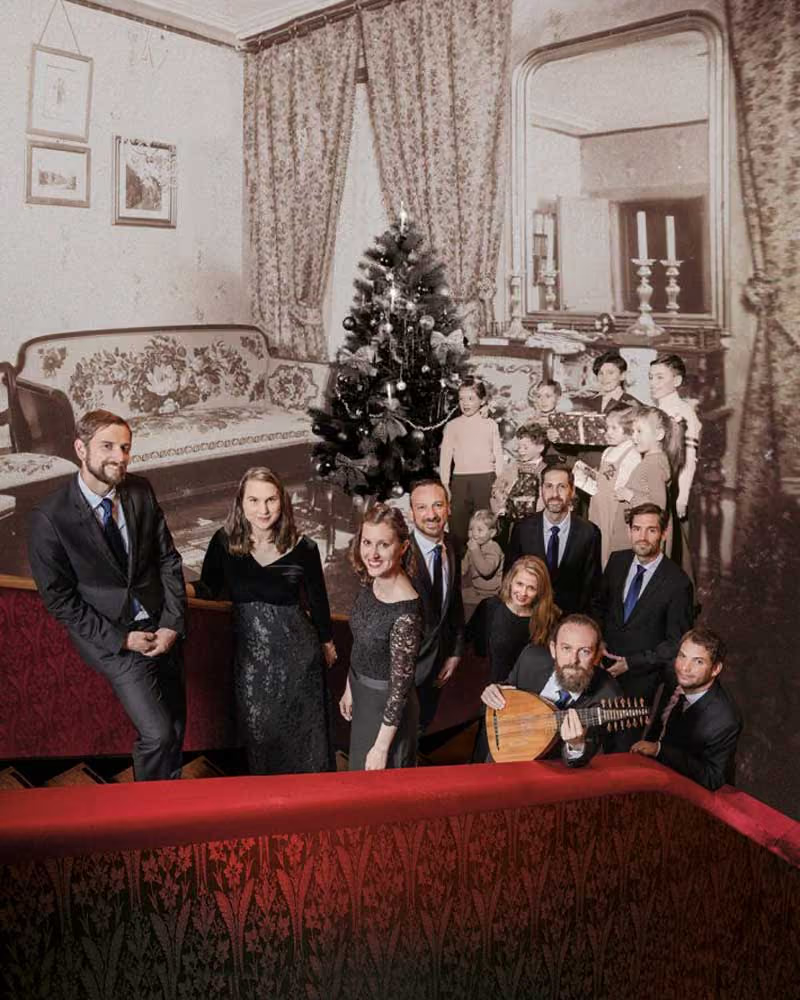
The solo vocal ensemble Voces Suaves from Basel gives historically informed performances of the music of the Renaissance and Baroque. Its warm, full-bodied sound and nuanced musical rhetoric make this ensemble’s interpretations unique and give their performances an emotional immediacy.
Voces Suaves was founded by Tobias Wicky in 2012 and comprises a core of eight professional singers, most of whom have a connection to the Schola Cantorum Basiliensis. Since 2016, the ensemble has worked without a permanent music director, developing their programmes on a collective basis. In this way, each individual member is required to exercise their creative drive, and all bear equal artistic responsibility. The line-up of the ensemble varies from programme to programme. When necessary, instrumentalists are also engaged. Voces Suaves has been invited to leading festivals across Europe, including the Festival d’Ambronay, the Ravenna Festival, the Festival Oude Muziek Utrecht, the Oslo International Church Music Festival, the Misteria Paschalia Festival in Krakow and the Innsbruck Festival of Early Music. They have also been invited to sing at the Berlin State Opera. From 2014 to 2016, the ensemble was part of “eeemerging”, the European funding programme for emerging ensembles. They enjoy collaborations with renowned ensembles such as the Ensemble Concerto Scirocco, the Akademie für Alte Musik Berlin, the Concerto Romano, Capriccio Stravaganza and the Capricornus Consort Basel. These make it possible for them to perform works needing larger forces. Voces Suaves also has a long-standing collaboration with the organists Michelle Vannelli, Jörg-Andreas Bötticher and Johannes Strobl.
Voces Suaves has released various recordings since 2015 on the labels Claves, Ambronay éditions, Arcana (Outhere Music) and Deutsche Harmonia Mundi. They have also been awarded various international prizes including the Diapason d’Or, the Diapason Découverte and the Choc de Classica.
For everyone who wants to hear Swiss symphonic music, and to live it too
Enjoy exclusivebenefits, get a glimpse behind the scenes, and do a good thing