Swiss Symphonic Music
Rediscovering the Swiss repertoire
_Komponist%2C_Musikpa%CC%88dagoge.avif)
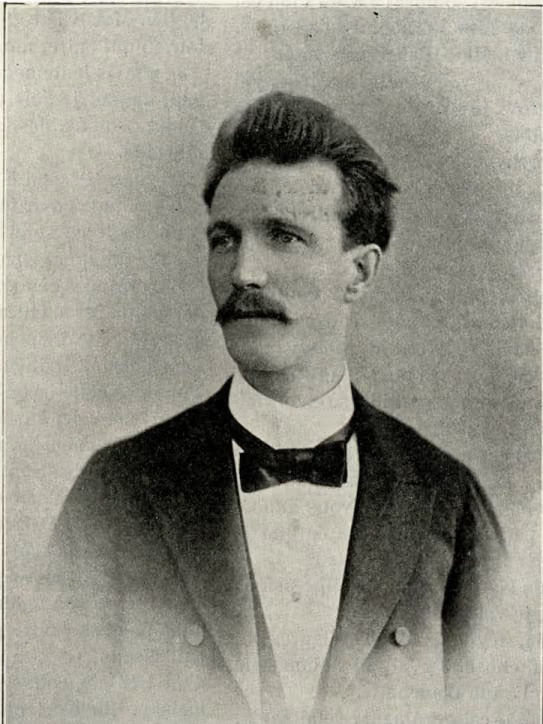
Hans Huber
1852 (EPPENBERG) – 1921 (LOCARNO)
Hans Huber was one of the most significant figures in recent Swiss music history. He was born in 1852 in Eppenberg in Canton Solothurn. After finishing his initial music training, he moved to Leipzig in 1870 to study under Carl Reinecke. He returned to Switzerland in 1877 and settled in Basel. He taught at the Basel Music School and conducted the Gesangverein, a choral society, and further helped his adopted city to achieve the status of a major musical metropolis by co-founding the Swiss Musician’s Association and the Basel Conservatory. He was awarded an honorary doctorate by the University of Basel in 1892, and today a hall at the main Basel concert venue, the Stadtcasino, bears his name.
Huber enjoyed international renown even during his own lifetime, and was regarded across Europe as the leading Swiss composer of his day. In 1901, his fellow Swiss Émile Jaques-Dalcroze described him as the “veritable chief of Swiss music”. He was also held in high regard by other Swiss colleagues such as Volkmar Andreae and Friedrich Hegar, and by major composers on the international scene including Richard Strauss, Max Reger and Ferruccio Busoni.
Besides his multifarious pedagogical activities and practical duties, Huber was also a prolific composer whose oeuvre ranges from operas to piano concertos, chamber music, oratorios, masses, cantatas and works in all the other standard genres of his time. Huber’s eight symphonies all bear descriptive subsidiary titles, thereby reflecting his having assumed the middle ground between absolute music and programme music.
Two of Huber’s symphonies are especially noteworthy: his Böcklin Symphony, which was inspired by an exhibition of Arnold Böcklin at the Basel Art Museum, and his Symphony No. 1 in D minor, op. 63, his Tell Symphony, whose first performance he himself conducted in Basel on 26 April 1881. In this work, Huber succeeded in capturing an archetypal image of Switzerland in sound as a testament to his love both of music and of his homeland.
works by
Hans Huber
Serenade No. 2 ‘Winter Nights’

Symphony No. 1 in D Minor, Op. 63 "A Tell-Symphonie"
I. Allegro ma non troppo. Più vivace
II. Adagio ma non troppo. Etwas bewegter. Tempoprimo. Più lento
III. Allegretto
IV. Andante. Allegro con fuoco