Swiss Symphonic Music
Rediscovering the Swiss repertoire
_OeNB_3781272_SO_WEB.avif)
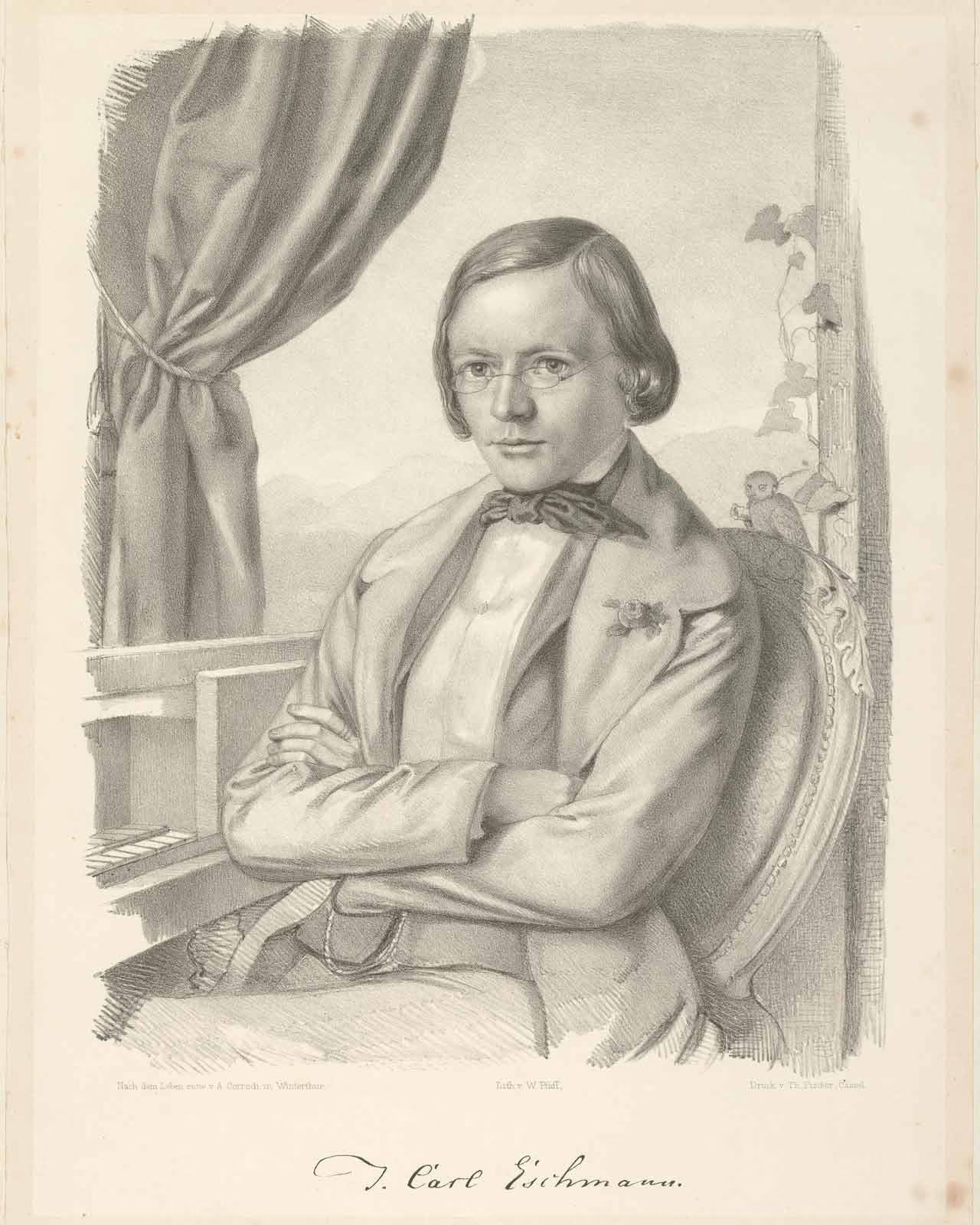
Joachim Raff
1822 (LACHEN) – 1882
Joachim Raff was born in 1822 in Lachen, a town on the banks of Lake Zurich. After completing his schooling, he worked as a primary school teacher in nearby Rapperswil before turning his attention to music instead. He was initially self-taught, and submitted his compositions to Felix Mendelssohn Bartholdy for assessment in 1843. Mendelssohn was so impressed by Raff’s music that he recommended it successfully to the renowned publisher Breitkopf & Härtel.
Not long afterwards, Raff met the piano virtuoso and composer Franz Liszt in Basel. Raff had no money to travel there, so reputedly made the journey all the way on foot from Zurich. Liszt was so impressed by the young man’s determination that he helped Raff to secure a job in a music shop, then later took him on as his assistant and secretary, fetching him to Weimar where Raff spent several years. He afterwards moved to Wiesbaden, where he experienced his most productive period as a composer. After more than 20 years there, Raff was made the first-ever Director of the Hoch’sche Conservatory in Frankfurt in 1877. His excellent reputation meant he was able to recruit renowned musical figures such as Clara Schumann and Julius Stockhausen to his staff. Raff died of a heart attack in 1882.
Raff was highly regarded as a teacher and also enjoyed a major reputation as a composer during his lifetime. He wrote numerous operas, choral works, symphonies, concertos, overtures, suites and chamber music. Raff was admired for his great skill as an orchestrator – a talent that he honed not least during his time as Liszt’s assistant in Weimar, when he had to help Liszt transform piano scores into orchestral works. Raff’s music was often performed in the 19th century, when it was ranked alongside that of Wagner and Brahms. In the 20th century, however, it fell into obscurity.
works by
Joachim Raff
Two Scenes for Voice and Orchestra, Op. 199
Two Scenes for Voice and Orchestra, Op. 199/1 «DIE JÄGERBRAUT»
Two Scenes for Voice and Orchestra, Op. 199/2 «DIE HIRTIN»