Swiss Orchestra Wind Soloists
CHF

About The Programme
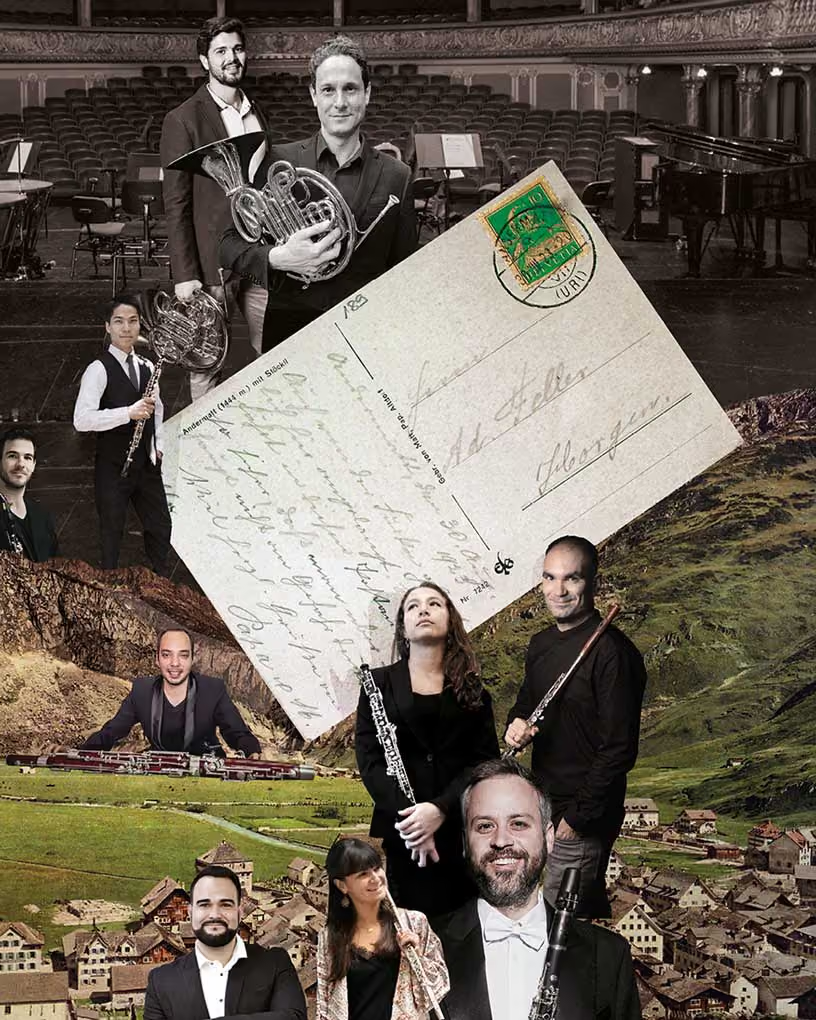
Beethoven would surely have been sceptical. His First Symphony, arranged for wind ensemble instead of large orchestra, with 10 musicians instead of 40, and no conductor? The Master had a number of derogatory terms for arrangements of his works: they were “canned [fodder], ragout, fricassee” with which “pie makers” – by which he meant unauthorised arrangers – made their money. But it was not just publishers who profited from the sale of arrangements. Beethoven’s works reached a far bigger public thanks to the broad distribution of popular arrangements for domestic use than they did in their original, orchestral versions. Today, of course, a full symphony orchestra has no problem fitting onto the Andermatt podium. But why shouldn’t we, too, have recourse to the old traditions of the “pie makers” and listen to Beethoven’s Symphony in a chamber version? Ten musicians from the Swiss Orchestra here conjure up a very special version of this work, using just the sound of flute, oboe, clarinet, horn and bassoon. The results might even have convinced the critical Master himself.
Charles Gounod, by contrast, deliberately opted for an all-wind ensemble when he wrote his “Petite symphonie pour vents”. The flute is the “secret” solo instrument in this work. This emphasis on the flute was a token of Gounod’s thanks to his friend Paul Taffanel, the outstanding French flautist of his day and the founder of the “Sociéte des Instruments à Vent”, the Society of Wind Instruments. It was Taffanel who commissioned the “Petite symphonie”, and its world première (in which he featured) helped to popularise this particular combination of wind instruments, as did his many other first performances of similarly scored works. Taffanel also arranged for a performance of Joachim Raff’s “Sinfonietta” in 1881 at a concert of his “Sociéte”. This was Raff’s sole work for an ensemble comprising only wind instruments, because his sudden death in 1882 meant that a new commission from Taffanel could no longer be realised. Even today, new chamber music for this particular formation is still being composed – thus our concert opens with the world première of “Souvenir d’Andermatt”, composed by Frederic Sánchez.
Lineup
SWISS ORCHESTRA WIND SOLOISTS:
ANNE-LISE TERUEL & FREDERIC SÁNCHEZ, flute
KELSEY MAIORANO & YUTA ONOUCHI, oboe
LIONEL ANDREY & GABOR HORVATH, clarinet
OSCAR SOUTO SALGADO & ALEJANDRO CELA CAMBA, horn
JOSÉ JAVIER ROMERO & DANIEL MOTA, bassoon
programme
FREDERIC SÁNCHEZ (*1987)
Souvenir d’Andermatt (world première)
LUDWIGVAN BEETHOVEN (1770–1827)
Symphony No. 1 in C major op. 21
CHARLESGOUNOD (1818–1893)
Petite Symphonie pour vents
JOACHIMRAFF (1822–1882)
Sinfonietta for ten wind instruments op. 188
concert hall
Andermatt

How to get there
Details on how to get there can be found on the ANDERMATT MUSIC website.
barrier-free access
The Andermatt concert hall is barrier-free. Wheelchair tickets are available via email at info@andermattmusic.ch or at Andermatt Alpine Apartments at +41 41 888 78 00.
Seating on the balcony is recommended for people with reduced mobility. Chamber music concerts and New Folk Music concerts usually do not have grandstand seating: Here, all seats are accessible without steps.
The Andermatt concert hall has an inductive listening system.
Garderobe
evening ticket office
The box office opens 1 hour before the start of the concert.
Doors open / late entry
Admission to the concert hall is 30 minutes before the start of the concert. Late admission is only possible during applause between plays and on the guidance of the hall staff.
Discount
Discounts are available for children, students and members of the Gotthard MemberClub. Details about the benefits can be found here.
For everyone who wants to hear Swiss symphonic music, and to live it too
Enjoy exclusivebenefits, get a glimpse behind the scenes, and do a good thing