The Swiss symphonic treasury
CHF

About The Programme
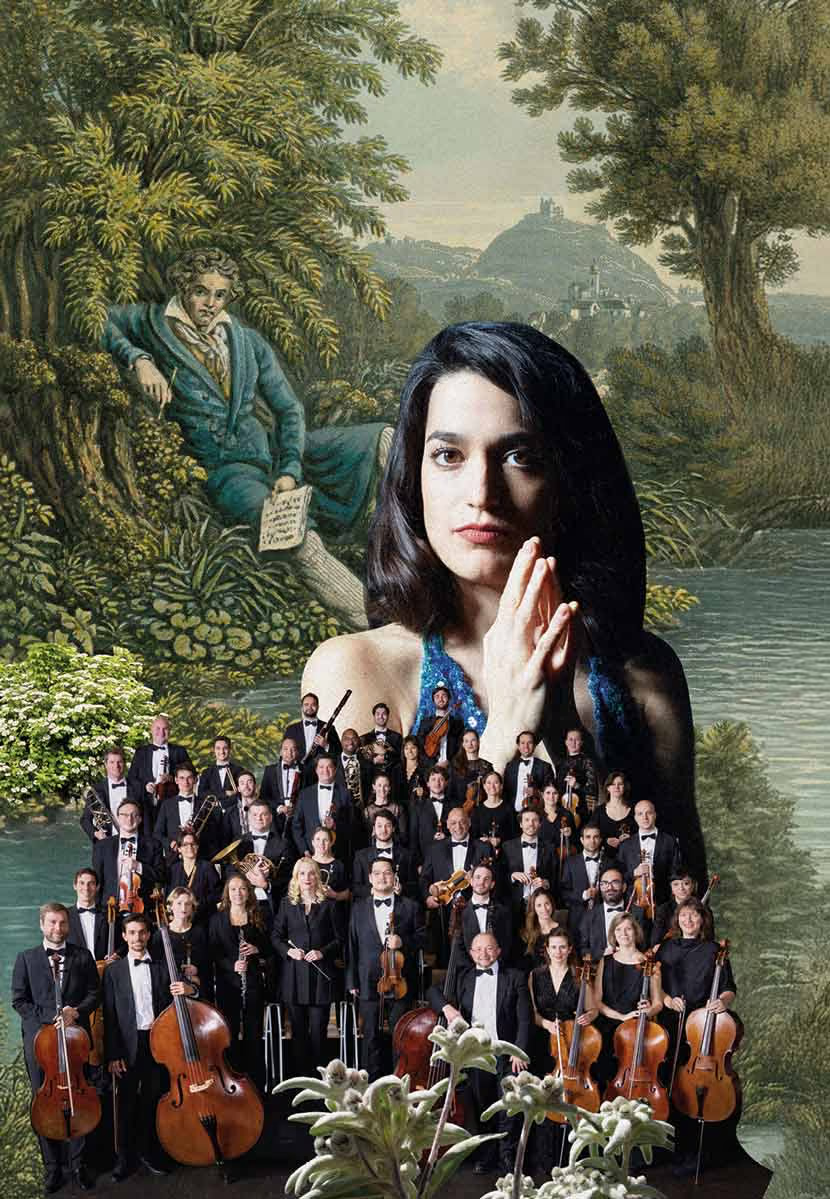
The relationship between Switzerland and Germany is sometimes rather complicated. Now and then, the Swiss refer to their northern neighbour charmingly as the “big canton”, but at other times they start to worry about their independence and develop feelings of insecurity towards everything German. And yet these two nations are interlinked by a long tradition of cultural exchange. German poets and artists have let themselves be inspired by the beauty of Switzerland, and the paths of composers from both countries have also often crossed, closely intertwining their respective biographies. Our programme entitled “The Swiss symphonic treasury” brings them together again.
When Richard Wagner had to flee Germany on account of his politics, he found temporary exile in Switzerland. He and the Swiss Joachim Raff from Lachen in Canton Schwyz knew each other well and corresponded with each other – though they also had an ambivalent relationship, especially after Raff published his near-300-page essay entitled The Wagner Question, in which he criticised his colleague’s compositional style as lacking profundity: “These melodies float on the surface of […] his harmonies like blobs of grease in a watery soup”. Although Raff was referring here to the overtures of Wagner’s operas, his criticism could also be applied to the song “Träume” (Dreams) from the Wesendonck Lieder, which Wagner composed in his Zurich exile. At the same time, however, Raff’s own style as a composer was influenced by Wagner. This makes the idea all the more appealing of juxtaposing Wagner’s song with Raff’s orchestral song Traumkönig und sein Lieb (“The dream king and his love”) and his Two scenes for mezzo-soprano and orchestra.
Felix Mendelssohn is represented here by his overture to “The fairy tale of the fair Melusine”. He is regarded as one of the early supporters of the young Raff, because he convinced the renowned publishing house Breitkopf & Härtel to accept the Swiss composer’s early works, thereby laying the foundations for Raff’s later career. Mendelssohn travelled across Switzerland several times, and just like Wagner he was enthusiastic about its mountainous regions. The German composer August Walter, in contrast, feared the Swiss countryside: “In fact, I have no desire to bury myself in a Swiss town where […] the cows are driven home from the fields on an evening!” But contrary to this assertion, Walter soon felt at home here, and in fact spent most of his life working in Basel, among the Swiss.
Lineup
MARIE-CLAUDECHAPPUIS, mezzo-soprano
SHERNIYAZMUSSAKHAN, violin
SWISS ORCHESTRA
LENA-LISA WÜSTENDÖRFER, conductor
programme
FELIX MENDELSSOHN BARTHOLDY
Overture to «The fair Melusine» op. 32
JOSEPH JOACHIM RAFF
«Two scenes» op. 199
«Traumkönig und sein Lieb» or voice and orchestra, op. 66
RICHARD WAGNER
«Träume» from the Wesendonck Lieder, WWV 91B
AUGUST WALTER
Symphony in E-flat major, op. 9
concert hall
Andermatt

How to get there
Details on how to get there can be found on the ANDERMATT MUSIC website.
barrier-free access
The Andermatt concert hall is barrier-free. Wheelchair tickets are available via email at info@andermattmusic.ch or at Andermatt Alpine Apartments at +41 41 888 78 00.
Seating on the balcony is recommended for people with reduced mobility. Chamber music concerts and New Folk Music concerts usually do not have grandstand seating: Here, all seats are accessible without steps.
The Andermatt concert hall has an inductive listening system.
Garderobe
evening ticket office
The box office opens 1 hour before the start of the concert.
Doors open / late entry
Admission to the concert hall is 30 minutes before the start of the concert. Late admission is only possible during applause between plays and on the guidance of the hall staff.
Discount
Discounts are available for children, students and members of the Gotthard MemberClub. Details about the benefits can be found here.
Marie-Claude Chappuis, won 2 Grammy Nominations. She sings regularly under the baton of famous conductors such as Riccardo Chailly, Daniel Harding, Emmanuelle Haïm, René Jacobs, Zubin Mehta, Riccardo Muti, Jonathan Nott and Christophe Rousset to name but a few. The milestones of her career so far included Idomeneo (Idamante) staged and conducted by Nikolaus Harnoncourt in Graz and Zurich, Paisiello’s Il Matrimonio Inaspettato (Contessa) under Riccardo Muti at Salzburg Festival, La Damnation de Faust (Marguerite) under Sir Roger Norrington in Leipzig and L’incoronazione di Poppea (Ottavia) at the Berlin State Opera and at the Brussels La Monnaie, to mention at least one of her numerous collaborations with René Jacobs. She is also a guest at the Maggio Fiorentino, the Theater an der Wien, the Opernhaus Zurich, the Théâtre des Champs-Elysées in Paris, the Teatro alla Scala, the Teatro Real in Madrid and the Grand Théâtre de Genève.
She is coequally active on concert-stage having recently sung with the Gewandhaus Orchestra Leipzig, the Orchestre de la Suisse Romande, the Giardino Armonico, the London Philharmonic Orchestra and the Wiener Philharmoniker. Her manifold discography includes Bach’s St. Matthew’s Passion with Riccardo Chailly (Decca), La Clemenza di Tito (Annio) with René Jacobs (released by Harmonia Mundi and nominated for a Grammy Award), Telemann’s Brockes-Passion and Mozart’s Requiem with the Freiburg Baroque Orchestra and René Jacobs (Harmonia Mundi 2017), Beethoven’s Ninth Symphony conducted by Giovanni Antonini (Sony 2018) as well as solo-albums with the lutenist Luca Pianca (“Sous l’empire d’Amour” – Deutsche Harmonia Mundi 2017) and folksongs from Switzerland (”Au coeur des Alpes“ – Sony Classical 2018). Just released: J.S. Bach’s h-minor Mass with the Akademie für alte Musik Berlin, the RIAS Kammerchor and René Jacobs (Harmonia Mundi) as well as Les Fables de La Fontaine with La Chapelle Harmonique (B-Records).
Sherniyaz Mussakhan, the concertmaster of the Swiss Orchestra, was born in 1993. He has performed as a soloist with the Royal Philharmonic Orchestra (London), the Basel Symphony Orchestra, the Astana Opera Symphony Orchestra and others. He has appeared at various festivals including the Gstaad Menuhin Festival, the Sion Festival and the Stars at the Rhein Festival, and has performed as a soloist at the Bolshoi Theatre, the Mozarteum in Salzburg, the Hofburg in Vienna, the Mariinsky Theatre in Saint Petersburg and in the Great Hall of the Moscow State Conservatory. In addition to his performing activities, Mussakhan is also the founder and artistic director of various cultural projects such as the Basel Infinity Festival, the YES Chamber Orchestra and the Dialoge Festival.
For everyone who wants to hear Swiss symphonic music, and to live it too
Enjoy exclusivebenefits, get a glimpse behind the scenes, and do a good thing