Pacific Quartet Vienna
CHF
85 / 75 / 60 / 45 / 35

About The Programme
Four seasons, four elements, four points of the compass – the number “four” has long had a deep significance to humanity, standing for the Earthly order in contrast to the divinity of the three-part God. Things in fours can be divided and reconstituted simply. The corner points of a square are always related to each other; and to take a musical example, the four musicians of a string quartet are all connected to each other too, communicating through their playing – like a conversation between four individual voices.
The transparent nature of the string quartet demands extraordinarily fine playing and the highest musical quality from its members. The intimacy of its instrumentation means that musical expression is its prime focus. This is arguably what has made the genre of the string quartet the supreme discipline in the world of chamber music. Wolfgang Amadeus Mozart’s “Hunt” Quartet is one of the high points of the genre. It got its nickname from the fanfare-like opening of its first movement, in which first the violins and then the viola imitate hunting horns. The second movement and the final, fourth movement are more dance-like and cheerful, while the Adagio third movement soars above them all: Here, the four voices of the quartet actually seem to speak to each other, to sing, and to lament, as if performing an operatic aria: whether alone, in duet or altogether.
Antonín Dvořák and Robert Schumann, on the other hand, offer a quite different perspective. Although Schumann engaged in an intensive study of Mozart’s chamber music, his String Quartet op. 41 No. 2 is more obviously influenced by Beethoven. The first movement is elegant and full of beauty; it is followed by a set of artful variations in the second movement, and restless melodic progressions in the third. Schumann’s last movement concludes cheerfully with a quotation from Beethoven’s song cycle To the Distant Beloved. Dvořák dispenses with the viola in his Bagatelles, instead inviting the harmonium to join the fray. There was a pragmatic reason for this: just such an instrument stood in the rooms of the chamber music association for which he wrote this work, and it made sense to use it. In Andermatt, this part will be played by the accordionist Olivia Steimel, who also lends her unmistakable timbre to Astor Piazzolla’s sensational tangos at the close of the concert.
Lineup
PACIFIC QUARTET VIENNA
YUTA TAKASE, violin
SIMON WIENER, violin
CHIN-TING HUANG, viola
SARAH WEILENMANN, violoncello
OLIVIA STEIMEL, accordion
programme
WOLFGANG AMADEUS MOZART:
String quartet in B-flat major K. 458 «The hunt»
ANTONÍN DVOŘÁK:
Bagatelles op. 47 for two violins, cello and accordion
ROBERT SCHUMANN:
String quartet in F major op. 41, No. 2
ASTOR PIAZZOLLA:
Five Tango Sensations
- 16.30Doors open
- 17.00concert (incl. break)
- 19:00Approx. end time
concert hall
Andermatt

How to get there
Details on how to get there can be found on the ANDERMATT MUSIC website.
barrier-free access
The Andermatt concert hall is barrier-free. Wheelchair tickets are available via email at info@andermattmusic.ch or at Andermatt Alpine Apartments at +41 41 888 78 00.
Seating on the balcony is recommended for people with reduced mobility. Chamber music concerts and New Folk Music concerts usually do not have grandstand seating: Here, all seats are accessible without steps.
The Andermatt concert hall has an inductive listening system.
Garderobe
evening ticket office
The box office opens 1 hour before the start of the concert.
Doors open / late entry
Admission to the concert hall is 30 minutes before the start of the concert. Late admission is only possible during applause between plays and on the guidance of the hall staff.
Discount
Discounts are available for children, students and members of the Gotthard MemberClub. Details about the benefits can be found here.
Yuta Takase, violin
Simon Wiener, violin
Chin-Ting Huang, viola
Sarah Weilenmann, violoncello
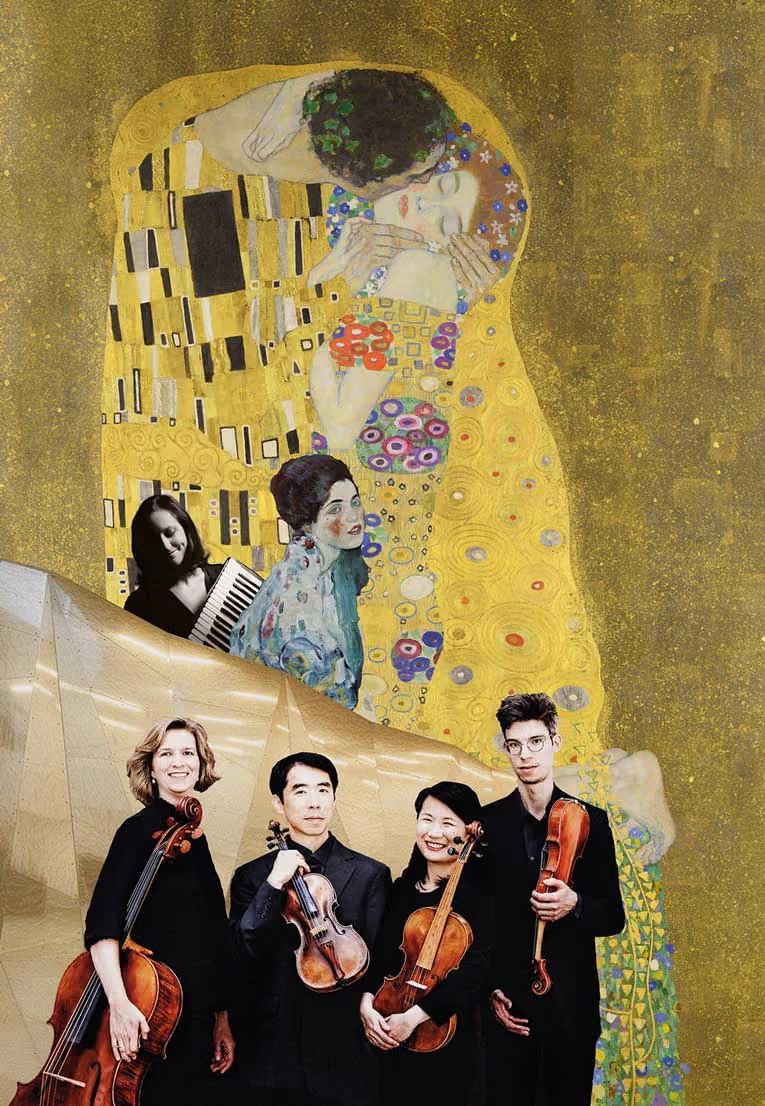
The four musicians of the internationally renowned Pacific Quartet Vienna (PQV), which is based in Vienna and Zurich, created their ensemble to celebrate their mutual passion for the quartet genre, generally regarded as the pinnacle of chamber music. Audiences all around the world have been thrilled by their sensitive, warm sound. They have a varied focus, regularly developing tailor-made concert programmes with an emphasis on contemporary music for performance in museums. Since it was founded, this Quartet has also engaged in an intensive exploration of the works of Viennese Classicism, but is furthermore involved in intercultural exchange programmes between Europe – Switzerland and Austria – and Asia – Japan and Taiwan, where they have made extensive tours in recent years. The high points of past concert seasons have included concerts at the Musikverein in Vienna, the Wigmore Hall in London and the Brucknerhaus in Linz, along with performances at renowned festivals such as the Styriarte (Graz), Wien Modern, the Trame Sonore Mantova Chamber Music Festival, the Haydn Festival Burgenland, the Kalkalpen Festival and the Lucerne Festival. They have also made several CD and radio recordings with the Gramola and Solo Musica labels, Swiss Radio and Television (SRF) and Ö1 in Austria. In 2015, the PQV won First Prize, the Audience Prize and the Prize for the best interpretation of a work by Joseph Haydn at the Sixth International Joseph Haydn Chamber Music Competition in Vienna. They also won the August Pickhardt Prize of the City of Basel in 2016 and the New Sound of Austrian Music Prize 2018/19 in 2017.
Olivia Steimel is a versatile accordion soloist and passionate chamber musician. Her artistic activities include regular world premieres, CD recordings and international radio and festival appearances throughout Europe and in Brazil, Georgia, Russia and Canada, e.g. Wien Modern, ECLAT Stuttgart, Darmstadt Summer Courses for New Music. She has performed as a soloist with the Basel Chamber Orchestra and the Augsburg Philharmonic Orchestra and has made guest appearances with musicAeterna, Ensemble Phoenix, Ensemble Aventure and the Basel Symphony Orchestra, among others. With the trio SÆITENWIND and the duo Steimel-Mücksch she has received numerous awards, e.g., at the Castelfidardo International Accordion Competition (1st prize), Concours Nicati Bern and the Karlsruhe Competition for the Interpretation of Contemporary Music. She studied in Würzburg, Basel and Weimar. From 2019 to 2023, she taught at the University of Music Würzburg. In the 2024/2025 season, she was Artist in Residence at the Staatstheater Augsburg.
For everyone who wants to hear Swiss symphonic music, and to live it too
Enjoy exclusivebenefits, get a glimpse behind the scenes, and do a good thing