«Belle Époque Suisse»
CHF

About The Programme
The «Belle Èpoque», «fin-de-siècle», «Edwardian Age»: the period between roughly 1880 and the beginning of the First World War in 1914 has been given many names. They all differ in their details, but nevertheless refer to the unusually long period of peace after the Franco-Prussian War that provided the basis for an upswing in the economy, technology and cultural life of Europe – though this «beautiful epoch» benefited the upper middle classes in particular. Culture flourished, and the bourgeoisie met on the boulevards of their metropolises, in the cafés and cabarets, studios and galleries, concert halls and salons. Improvements in transport served to open up remote areas, and the increased availability of leisure time meant that pleasure trips became more and more attractive. Outside the metropolises, fine hotels were built in the Alps for a wealthy clientele – such as the Grandhotel Bellevue in Andermatt, whose place has today been taken by «The Chedi».
Sergei Rachmaninoff’s summer domicile was in Weggis in Canton Lucerne; the Swiss composer Hans Huber spent his twilight years partly in Vitznau (also in Canton Lucerne); and the last three years of Richard Strauss’s life were spent mostly in Swiss hotels. These three composers are all at the heart of the Swiss Orchestra’s New Year Concert programme. Gustav Mahler’s popular Adagietto is also on the programme, as is Camille Saint-Saëns’s symphonic poem «Danse macabre» and the Humoresque and Cavatina by Hans Huber.
The soloists for this concert will be the soprano Lena Kiepenheuer and the harpist Alexander Boldachev, whose contributions will include Rachmaninoff’s «Vocalise» for soprano, harp and strings. Jules Massenet’s popular «Méditation» from his opera «Thaïs» is representative of the sentimental style of the fin-de-siècle, and it is here placed alongside Joseph Lauber’s Suite for String Orchestra and two New Year’s classics by Johann Strauss (Father and Son). And finally, Richard Strauss’s orchestral song «Morgen» will offer an optimistic vista: «And tomorrow the sun will shine again / and on the path that I shall take / the sun will unite us again, we happy ones, / in the midst of this sun-breathing earth…».
Lineup
SWISS ORCHESTRA
LENA-LISA WÜSTENDÖRFER, conductor
FRANZISKA HEINZEN, soprano
ALEXANDER BOLDACHEV, harp
SHERNIYAZ MUSSAKHAN, violin
programme
HANS HUBER (1852 – 1921)
Humoreske. Allegro vivace
Cavatina. Adagio molto espressivo
RICHARD STRAUSS (1864 –1949)
«Morgen» op. 27, Nr. 4
SERGEI RACHMANINOW (1873 – 1943)
Vocalise
CAMILLE SAINT-SAËNS (1835 – 1921)
«Danse macabre»
GUSTAV MAHLER (1860 – 1911)
Adagietto (aus Sinfonie Nr. 5)
JOSEPH LAUBER (1864 – 1952)
Suite pour Orchestre à Cordes
JULES MASSENET (1842 –1912)
Méditation (from the opera «Thaïs»)
JOHANN STRAUSS (SOHN, 1825– 1899)
Annen-Polka
JOHANN STRAUSS (VATER, 1804– 1849)
Radetzky-Marsch
Kunsthaus
Zurich

How to get there
BY PUBLIC TRANSPORT
Tram lines 3, 5 and 9 and bus 31 to the Kunsthaus stop
BY CAR
Hohe Promenade car park
Public parking spaces at Hirschgraben and at the Zurich Higher Court
barrier-free access
PARKING SPACE FOR PEOPLE WITH REDUCED MOBILITY
At the Chipperfield building at Kantonsschulstrasse 4, you will find 2 Kunsthaus parking spaces
WHEELCHAIR
Up to one week before the concert, wheelchair spaces can be booked by writing an email to info@swissorchestra.ch
Garderobe
evening ticket office
Doors open / late entry
Discount
ZKG members
Students and trainees up to 30 years of age as well as KulturLegi holders
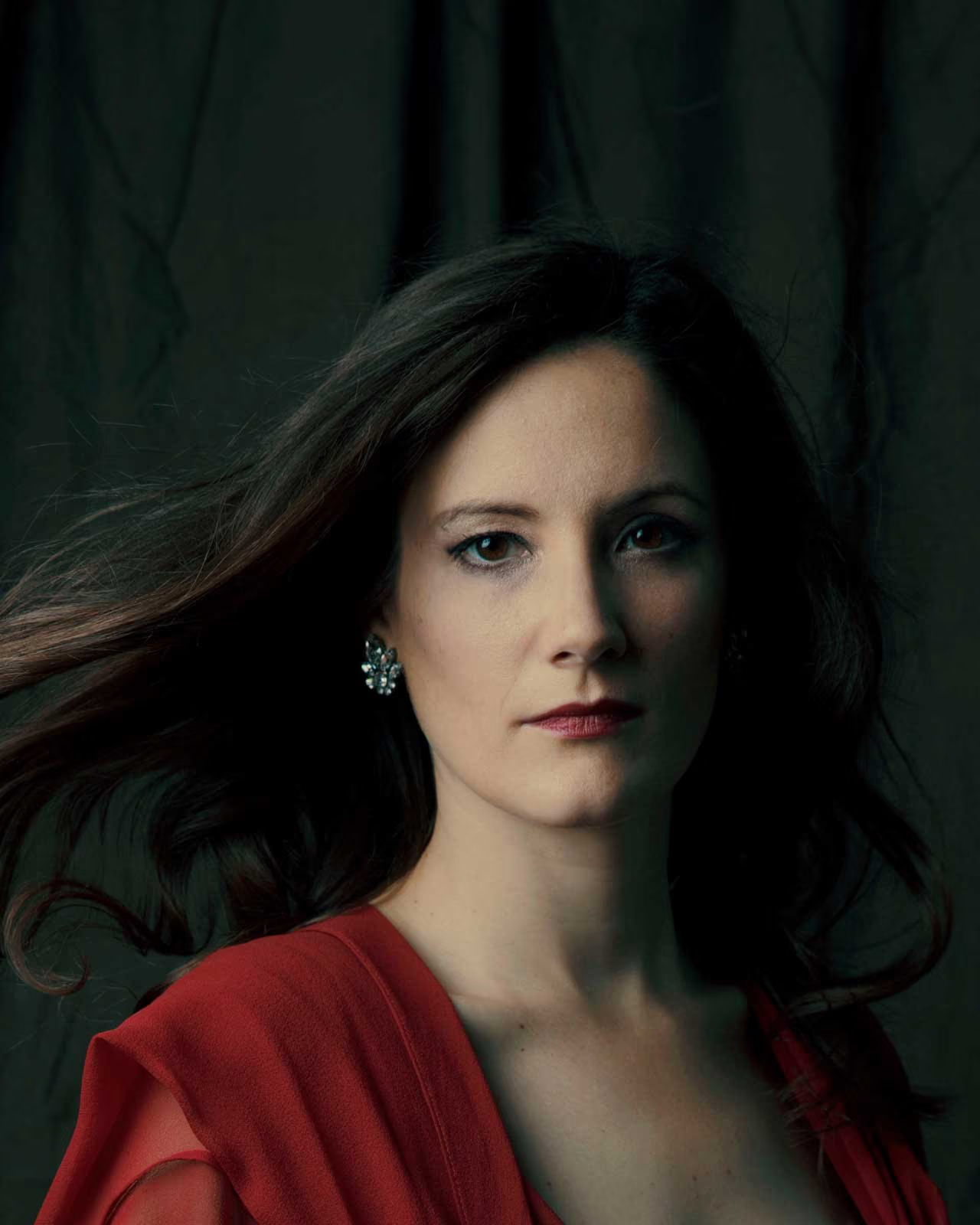
In addition to a special affinity for Lieder, the Swiss soprano Franziska Heinzen dedicates herself to the great soprano roles in opera and oratorio. She has performed chamber works by Dieter Schnebel at the Mozartfest in Würzburg, Mozart’s Mass in C minor with the Zurich Chamber Orchestra and Berg’s Seven Early Songs with the Nordwestfälische Philharmonie. Joint recitals with the pianist Benjamin Mead have led them to the Schubertiada Vilabertran, the Schumannfest Düsseldorf and elsewhere.
Her debut album on SoloMusica, celebrating 100 years of Les Six, and her second CD featuring songs by 24 women composers from the Romantic period to the present day, were highly praised by the international press for both her interpretation and her programmes. This journey of discovery is being continued with a recording of Swiss compositions in 2022. In 2017 she received the Cultural Endowment Award of the Canton of Valais and in 2018 she founded the “rhonefestival for the art of song” in her hometown of Brig.
Alexander Boldachev is a virtuoso harpist, composer, teacher, and founder of the Zurich Harp Festival. He received a Master’s degree from the Zurich Academy of Arts, studying with Catherine Michel (harp), Mathias Steinauer (composition) and Marc Kissoczy (conducting). He has won awards at over a dozen international competitions including the “Prix Walo” and the “ProEuropa”.
Alexander Boldachev has performed in the USA, England, Canada, France, Japan, Brazil, China, Singapore, Hong Kong, Indonesia, Germany, Switzerland, Turkey, Argentina, Hungary, Italy, Russia and elsewhere, and has been a guest at Carnegie Hall in New York, the Musikverein in Vienna and the Great Philharmonic Hall in St. Petersburg. In 2018, he wrote and performed an electronic harp solo at the FIFA World Cup Opening Ceremony, sharing the stage with Robbie Williams and Aida Garifullina. Boldachev was given the prize for the “Best Rock Cover Song” at the Akademia Music Awards in Los Angeles, for a unique performance of the song “Californication” by the American band Red Hot Chili Peppers.
For everyone who wants to hear Swiss symphonic music, and to live it too
Enjoy exclusivebenefits, get a glimpse behind the scenes, and do a good thing