Swiss Connections
CHF
75 / 60

About The Programme
«Swiss connections» is the motto of the Swiss Orchestra as we guide you into the New Year in 2026 – and to ring it in, we’re taking you on a musical journey from Switzerland, via Paris, to America. Along the way, the supposed boundaries between the profundity of European music and the reputed frivolousness of the New World become thoroughly blurred.
At the turn of the 20th century, the European railway network meant that destinations like Paris suddenly became easily accessible, while ocean liners managed to shrink previously imponderable distances to bring even places like New York closer. This globalisation also left its impact on the music scene. Many a young composer was now able to try his luck in a metropolis, immersing himself in a different language and culture and in new musical styles. Joseph Lauber was born in Ruswil in Canton Lucerne and initially studied in Zurich before being drawn to Paris. He moved to Geneva in the early 20th century and was soon appointed a professor at the Conservatory. Lauber composed his string suite Les Automnales in 1944, depicting life in autumn in four vivid movements. Pierre Maurice and Ernest Bloch were both from French-speaking Switzerland and both also studied in Geneva. Bloch then left for Paris, but soon went much farther still when his success at a guest performance in America enabled him to emigrate there. In 1941, he settled for good on the West Coast of the USA. It was there that he composed his Concerto grosso No. 2, filling its austere, Baroque form with new worlds of sound.
European composers might have felt drawn to the USA, but there was an ample number of Americans who travelled in the opposite direction. The reason was simple – anyone who wanted to become someone in the 1920s simply had to study with Nadia Boulanger in Paris. Aaron Copland, originally from New York, made sure he didn’t omit this step on his educational ladder. Once he was back home, he made a name for himself as a composer of symphonic jazz who, not unlike George Gershwin or Kurt Weill, was able to unite these two seemingly incompatible genres. The multifaceted clarinet, with its propensity for stylistic variability, proved the ideal instrument for mediating between jazz and the classical, so it’s not surprising that Copland wrote a solo concerto for it. The soloist in the Swiss Orchestra’s New Year Concert is the clarinettist Reto Bieri from Canton Zug. His own studies took him to New York, so he’s a perfect embodiment of the Swiss-American connections at the heart of our concert programme.
Lineup
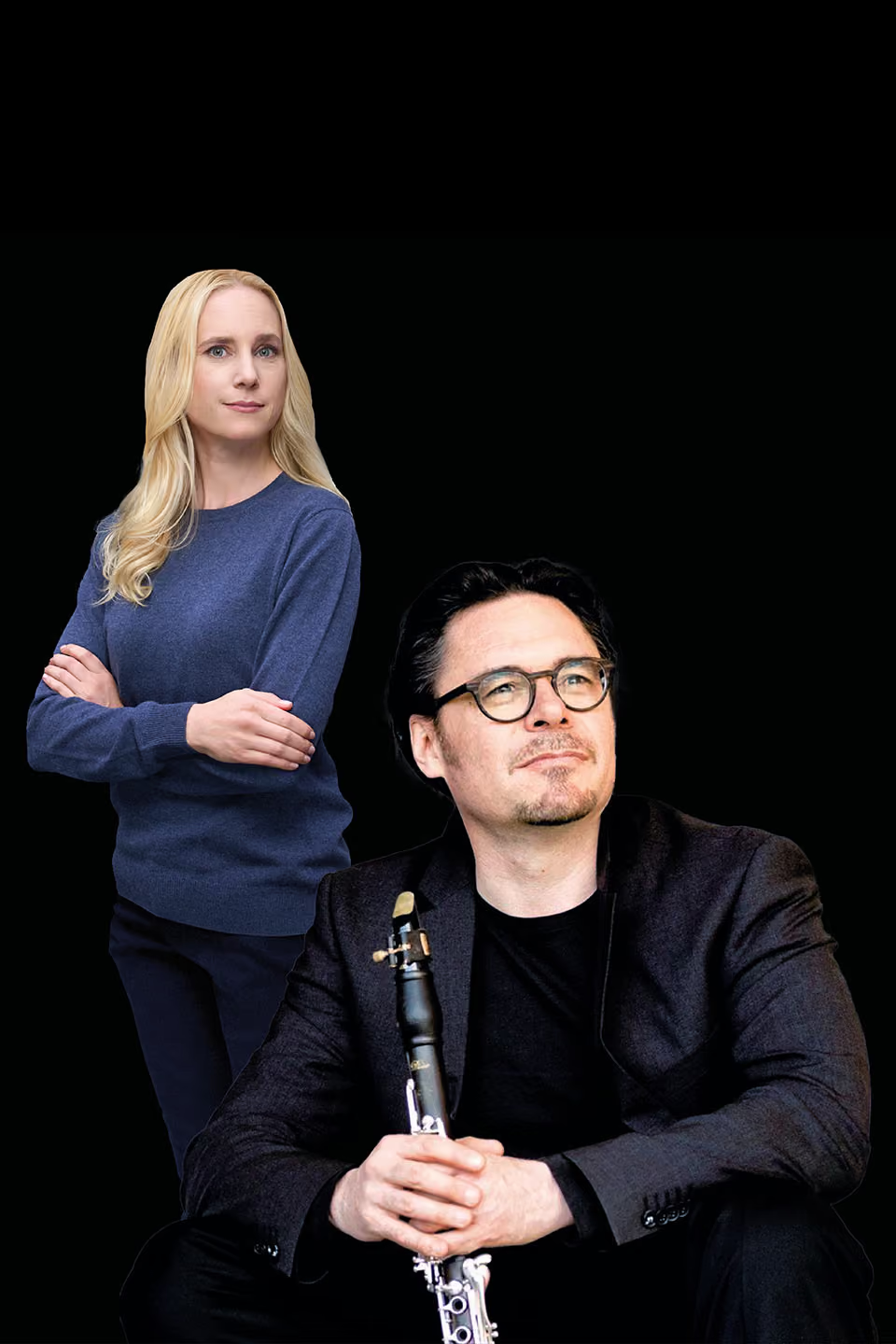
RETO BIERI, clarinet
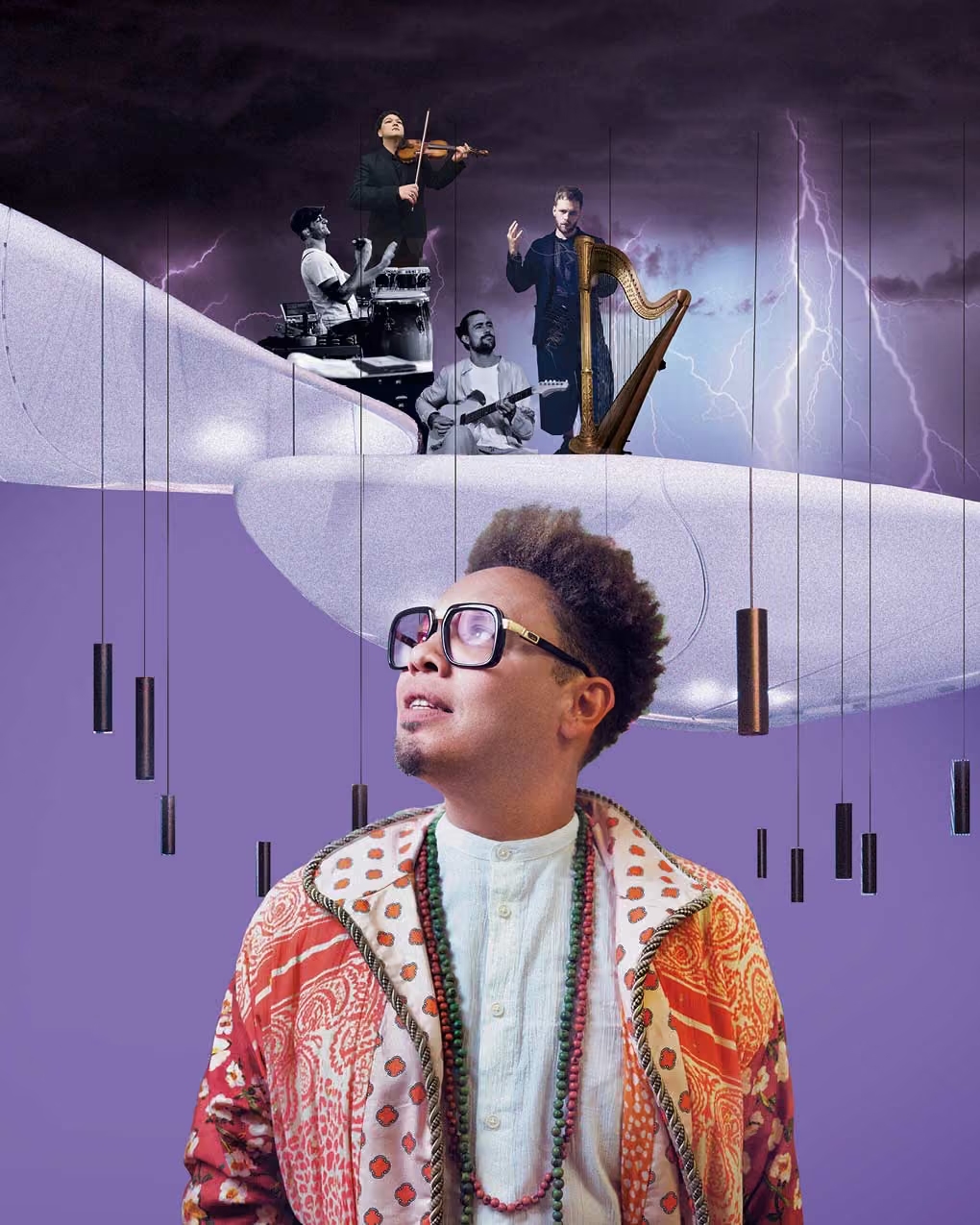
SHERNIYAZ MUSSAKHAN, violin
ALEXANDER BOLDACHEV, harp
SWISS ORCHESTRA
LENA-LISA WÜSTENDÖRFER, conductor
programme
JOSEPH LAUBER (1864–1952)
«Les Automnales» for string orchestra
JULES MASSENET (1842–1912)
«Méditation» from «Thaïs» (Violin solo: Sherniyaz Mussakhan)
PIERRE MAURICE (1868–1936)
Fugue instrumentale for strings, op. 20
AARON COPLAND (1900–1990)
Concerto for Clarinet and Orchestra
GEORGE GERSHWIN (1898–1937)
«Promenade – Walking the Dog» (arr. Reto Bieri)
KURT WEILL (1900–1950)
«Youkali» (arr. Reto Bieri)
BREAK
ERNEST BLOCH (1880–1959)
Concerto Grosso No. 2 for strings
CAMILLE SAINT-SAËNS (1835–1921)
«Danse Macabre» (arr. and harp solo: Alexander Boldachev)
JOHANN STRAUSS (SOHN,1825–1899)
Annen-Polkaop. 117
JOHANN STRAUSS (VATER,1804–1849)
Radetzky-March
- 16:30Doors open
- 17:00Start of concert
- 19:00Approx. end time
Kunsthaus
Zurich

How to get there
BY PUBLIC TRANSPORT
Tram lines 3, 5 and 9 and bus 31 to the Kunsthaus stop
BY CAR
Hohe Promenade car park
Public parking spaces at Hirschgraben and at the Zurich Higher Court
barrier-free access
PARKING SPACE FOR PEOPLE WITH REDUCED MOBILITY
At the Chipperfield building at Kantonsschulstrasse 4, you will find 2 Kunsthaus parking spaces
WHEELCHAIR
Up to one week before the concert, wheelchair spaces can be booked by writing an email to info@swissorchestra.ch
Garderobe
evening ticket office
Doors open / late entry
Discount
ZKG members
Students and trainees up to 30 years of age as well as KulturLegi holders
The Swiss clarinettist Reto Bieri is one of the most fascinating musical personalities of our time. As a soloist, chamber musician, curator and, more recently, as a conductor too, he engages with works from all manner of epochs and in very different styles, often in unconventional concert programmes. He’s a poet in sound and a maverick who happily crosses boundaries on his hunt for extraordinary sensibilities and perceptions. The *Luzerner Zeitung* described Bieri’s recent concert project “Out of the box” at the Lucerne Festival as “the craziest event in the whole Festival”.
Bieri was born in Canton Zug and grew up with traditional folk music. He initially trained as a primary school teacher before studying at the music academies of Basel and Zurich, then later at the Juilliard School of Music in New York. He has been influenced by a wide variety of personalities, from the composers György Kurtág, George Crumb and Heinz Holliger to the conductor Nikolaus Harnoncourt, the violinist Eberhard Feltz, the priest Werner Hegglin, Dimitri the clown and the writer Gerhard Meier. Bieri plays regularly with renowned orchestras in major concert halls – most recently at the Auditorio Nacional de Música in Madrid, the Wigmore Hall London, the London Southbank Centre, the Konzerthaus in Vienna, the Philharmonie Essen, the Elbphilharmonie in Hamburg, the KKL Lucerne, the Théâtre du Jeu de Paume in Aix-en-Provence, the Romanian Athenaeum in Bucharest, the Franz Liszt Music Academy in Budapest, the Amsterdam Concertgebouw and the Basel Theatre. Bieri’s CD recordings – including his highly acclaimed album *quasi morendo* with the Meta4 String Quartet from Finland – are available on the cult label ECM of Munich. In 2023, Bieri was awarded the Cultural Prize of the Canton of Zug. From 2013 to 2018 he was the Artistic Director of the “DAVOS FESTIVAL – young artists in concert” in Switzerland. From 2012 to 2022 he was a professor of chamber music at the Music Academy of Würzburg in Germany, and in 2022 he was appointed a professor of chamber music at the University of Music and Theatre in Munich, where he still works today.
For everyone who wants to hear Swiss symphonic music, and to live it too
Enjoy exclusivebenefits, get a glimpse behind the scenes, and do a good thing