Brilliantly Swiss
CHF

About The Programme
On 8 February 1935, the Viennese-born, Austrian-American violinist-composer Fritz Kreisler saw himself compelled to make a statement to the New York Times to clarify a growing scandal: “Some 30 years ago, circumstances forced me to take this course of action when I wanted to expand my concert repertoire. It seemed improper and tactless to me to put my name repeatedly on my programmes”. So what had happened? According to his own account, Kreisler – a child prodigy who had advanced to become the star violinist of the first half of the 20th century – had acquired manuscripts of music by older composers such as Gaetano Pugnani, François Couperin and Antonio Vivaldi, who at the time were essentially unknown. He had then “arranged” them for violin, published the resultant music and played these works in his concerts. It was the music critic Olin Downes who finally revealed that many of these supposedly Baroque works had in fact been composed by Kreisler himself. They were “forgeries” – and this triggered a perfect scandal on the classical music scene, one that was reported all over the world.
Many thought it all an amusing joke, though it left a nasty taste in the mouth of some critics, Ernest Newman in particular: “How easy it is, and always has been, to write this kind of music […] Anyone with the slightest inkling of music in him, and the slightest knowledge of the period in question, could produce something like this every morning, using only the hand that he doesn’t need for shaving”. But this detracts not a whit from the popularity of Kreisler’s compositions, as we can confirm in this concert with the Swiss Orchestra and the high-flying violin virtuoso Sebastian Bohren. He here presents a selection of works including Kreisler’s Prelude and Allegro – initially attributed to Pugnani – plus pieces in the Viennese style, such as the popular “Liebesfreud”, alongside Giuseppe Tartini’s virtuoso “Devil’s Trill” Sonata and Paul Juon’s Berceuse.
Two little-known, late-Romantic Swiss works are also on our programme: the 5 Pieces by Paul Juon, whose family roots were in Canton Graubünden, and a chorale by George Templeton Strong, who grew up in Geneva. The Swiss Orchestra’s signature feature is rediscovering unjustly forgotten works of Swiss music from the Classical and Romantic periods, and combining them with more famous works. And so Edvard Grieg’s popular “Holberg Suite” rounds off our diverse concert programme today.
Lineup
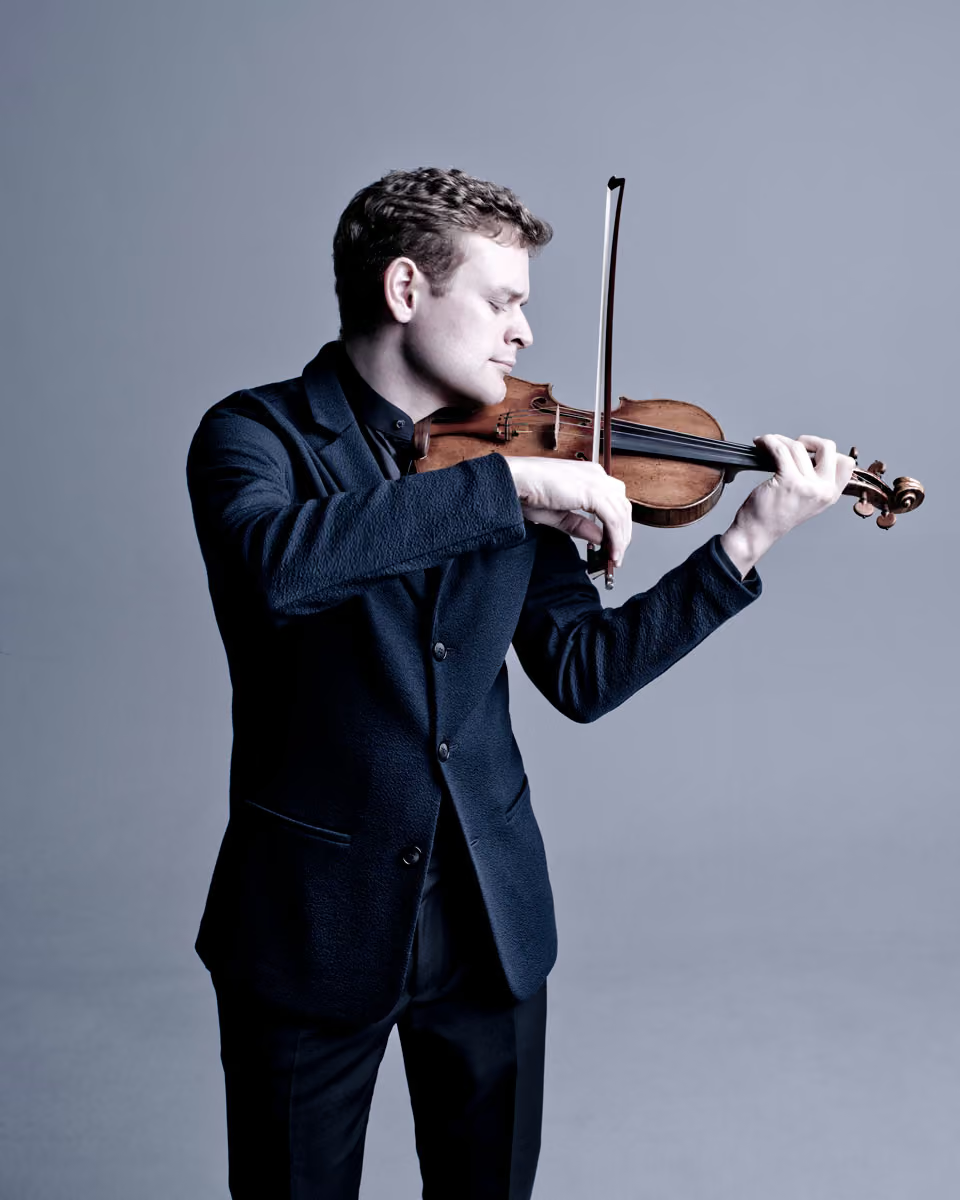
SEBASTIAN BOHREN, violin
SWISS ORCHESTRA
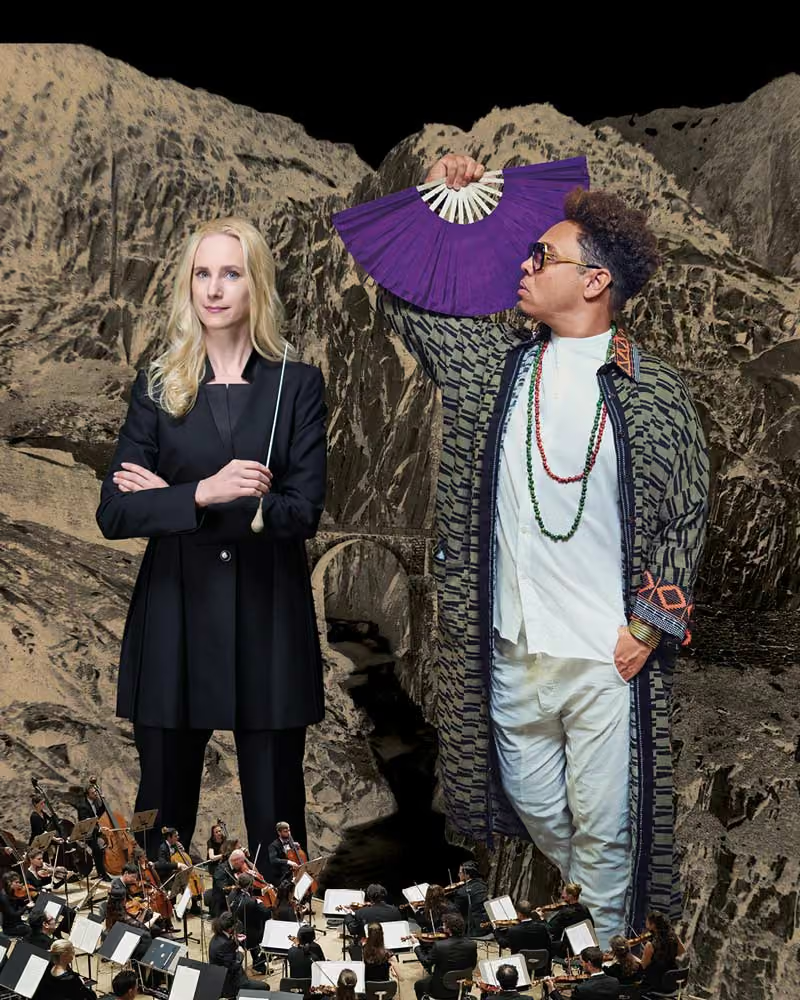
LENA-LISA WÜSTENDÖRFER, conductor
programme
PAUL JUON (1872 – 1940 VEVEY)
5 Pieces for String Orchestra op. 16
4 Pieces for Violin and Piano (version for violin and orchestra) op. 28 No. 3, Berceuse
GIUSEPPE TARTINI (1692–1770)
Sonata in g minor «The Devil’s Trill» (arr. Fritz Kreisler)
FRITZ KREISLER (1875–1962)
Prelude and Allegro Variations on a Theme of Corelli
«Liebesfreud»
«Schön Rosmarin»
EDVARD GRIEG (1843–1907)
Holberg Suite op. 40
GEORGE TEMPLETON STRONG (1856 – 1948GENF)
Chorale on a Theme of Leo Hassler
JOHANN STRAUSS (SOHN,1825–1899) UND
JOSEFSTRAUSS (1827–1870)
Pizzicato-Polka
JOHANN STRAUSS (VATER,1804–1849)
Radetzky-March
Kunsthaus
Zurich

How to get there
BY PUBLIC TRANSPORT
Tram lines 3, 5 and 9 and bus 31 to the Kunsthaus stop
BY CAR
Hohe Promenade car park
Public parking spaces at Hirschgraben and at the Zurich Higher Court
barrier-free access
PARKING SPACE FOR PEOPLE WITH REDUCED MOBILITY
At the Chipperfield building at Kantonsschulstrasse 4, you will find 2 Kunsthaus parking spaces
WHEELCHAIR
Up to one week before the concert, wheelchair spaces can be booked by writing an email to info@swissorchestra.ch
Garderobe
evening ticket office
Doors open / late entry
Discount
ZKG members
Students and trainees up to 30 years of age as well as KulturLegi holders
Swiss violinist Sebastian Bohren has forged a distinctive career as a world-class soloist, empathetic chamber musician and collaborator, acclaimed recording artist and inspired entrepreneur. With a wide-ranging repertoire that spans the Classical era to the present day, he has been praised for his “bravura playing” (The Sunday Times) and interpretations imbued with “charm and elegance” (The Strad). Highlights of Sebastian Bohren’s concerto appearances are Mendelssohn and Szymanowski with Andrew Manze and the Royal Liverpool Philharmonic Orchestra; Beethoven with Michael Sanderling and the Lucerne Symphony Orchestra; Mendelssohn and Eötvös with Ivor Bolton and Sinfonieorchester Basel; Bartok with Heinz Holliger and the Orchestra della Svizzera italiana; Lindberg and Vasks with Thierry Fischer and the Munich Chamber Orchestra; Pärt and Schnittke with Daniel Hope and the Zurich Chamber Orchestra; Mozart with Marc Minkowski and the Basel Chamber Orchestra; Beethoven with Cristian Macelaru and the Romanian Chamber Orchestra; and Mendelssohn with Christoph Poppen and the Cologne Chamber Orchestra. Sebastian Bohren’s entrepreneurial flair led to his establishing the Swiss-based Brugg Festival in 2023, a week-long gathering that hosts a variety of musicians and offers a robust educational element. Sebastian Bohren plays a 1761 violin made in Parma by Giovanni Battista Guadagnini, the “Ex-Wanamaker-Hart”.
For everyone who wants to hear Swiss symphonic music, and to live it too
Enjoy exclusivebenefits, get a glimpse behind the scenes, and do a good thing