swiss symphony in focus
CHF

About The Programme
Johann Carl Eschmann from Winterthur studied with Felix Mendelssohn Bartholdy and Ignaz Moscheles in Leipzig before working as a piano teacher and composer in his hometown as well as in Schaffhausen and Zurich. He belonged to Richard Wagner’s inner circle and was also friends with Johannes Brahms, who held him in high esteem as a composer. Eschmann’s works were stylistically influenced by Robert Schumann and Felix Mendelssohn. Nevertheless, he developed his own musical language at an early age, with unexpected rhythmic subtleties and harmonic twists and turns. His Grand Concert Overture of 1847 is one of his early compositions and remained (unfortunately) his only work for orchestra.
In contrast to Eschmann, Frank Martin from the French-speaking part of Switzerland is one of the better-known personalities among Swiss composers. At the request of his parents, he began to study mathematics and physics in Geneva, but devoted himself more and more to composition. In Geneva he then worked closely with Emile Jaques-Dalcroze and founded the “Société de musique de chambre” to cultivate the music of the 17th and 18th centuries. In addition to his great vocal works, Martin composed sophisticated instrumental music. For example, the Three Dances for oboe, harp, string quintet and string orchestra with their flamenco rhythms. “Trois Danses” was first performed on 9 October 1970 in Zurich under the baton of Paul Sacher with soloists Heinz and Ursula Holliger.
After the interval, Johannes Brahms‘ third symphony builds a bridge to the romantic beginning of this concert. His 3rd symphony was composed in 1883 and thus falls into the period of the so-called “music dispute” between representatives of the New German School, who saw the future of music in symphonic tone poetry and programme music, and the advocates of “absolute” music free of extra-musical content, to whom Brahms also belonged. The latter were of the opinion that music should not be measured by programmatic statements but solely by inner-musical artistic claims, as was customary in Viennese classical music. Not surprisingly, therefore, the response to this work was divided. While some rejected it, others went into raptures. Thus Antonín Dvořák wrote to his publisher Simrock “What wonderful melodies are to be found there! It is pure love, and one’s heart opens up to it”. And Clara Schumann wrote to Brahms: “…every movement is a jewel! – How bewitched one is from beginning to end by this mysterious magic…”
Lineup
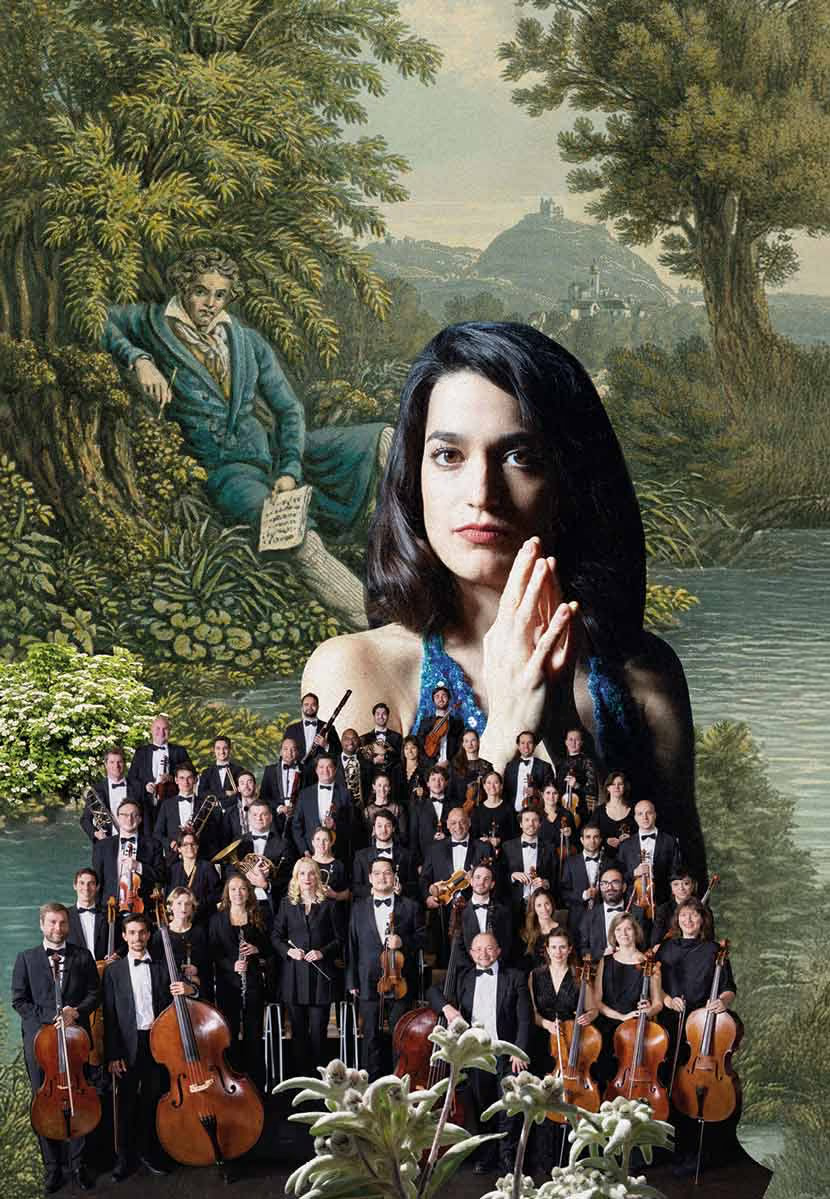
SWISS ORCHESTRA
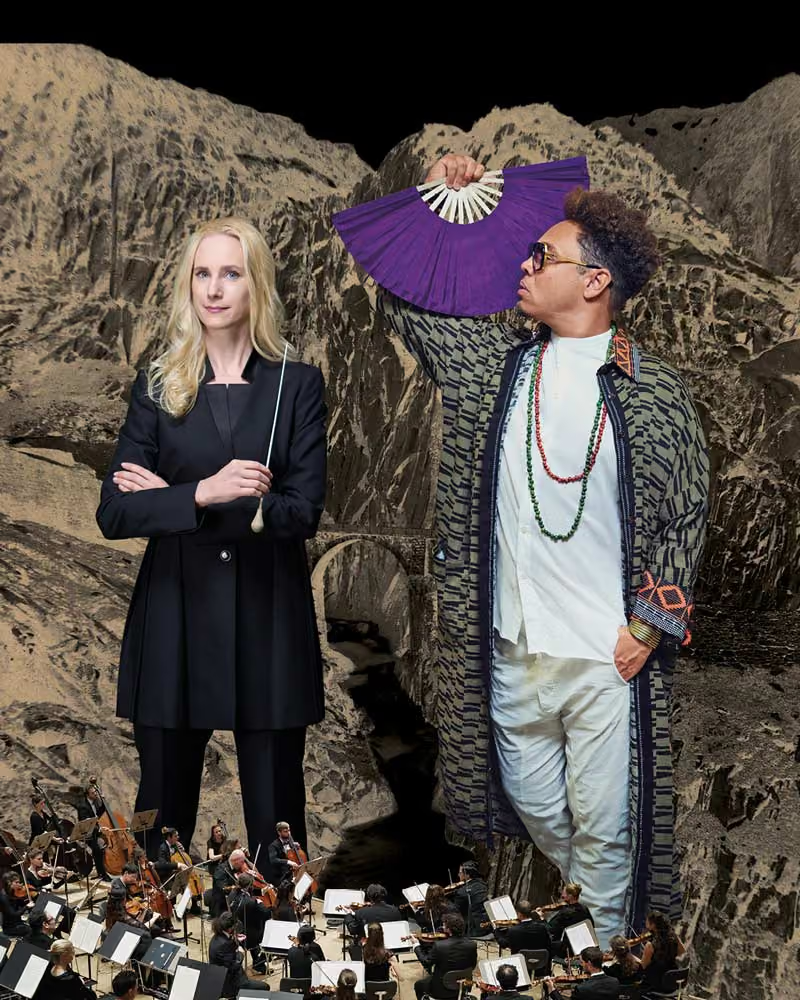
LENA-LISA WÜSTENDÖRFER, conductor
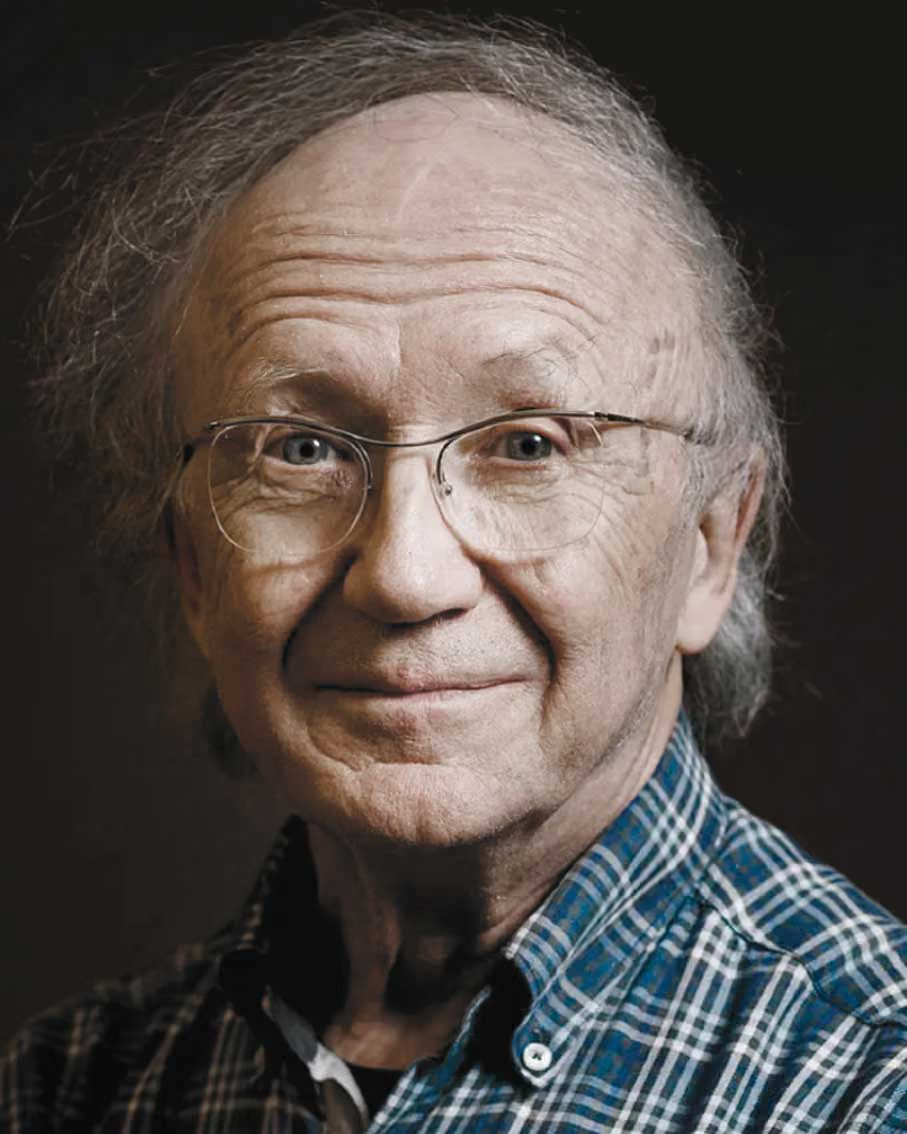
HEINZ HOLLIGER, oboe
ALICE BELUGOU, harp
programme
JOHANN CARL ESCHMANN (1826–1882)
Grand Concert Overture
FRANKMARTIN (1890–1974)
Three Dances for oboe, harp, string quintet and string orchestra
JOHANNES BRAHMS (1833–1897)
Symphony No. 3, op. 90
Stadtcasino
Basel

How to get there
BY PUBLIC TRANSPORT
About 10 minutes on foot from Basel main station
Tram lines 3/6/8/11/14/15/16/17 to «Barfüsserplatz»
BY CAR
Parking Kunstmuseum Basel
barrier-free access
WHEELCHAIR ACCESSIBLE
Stadtcasino Basel is completely wheelchair accessible. In the music hall as well as in the Hans Huber Hall, there are seats for wheelchair users in various categories. Seats for accompanying persons are available in the immediate vicinity of the wheelchair spaces.
Depending on availability, wheelchair spaces can be purchased directly from the respective organizers.
The appropriate sanitary facilities are located in the first basement and can be reached by lift.
HEARING IMPAIRMENT
The seats on the floor of the music hall and the Hans Huber hall are equipped with an induction loop.
People with hearing aids can thus receive amplified music and speeches wirelessly, provided that their own hearing aid is equipped with an appropriate receiver.
Please refer to the seating plans from music hall and from Hans Huber Hall, the seats with an ideal range of action of the hearing system.
VISUAL IMPAIRMENT
Service dogs may be brought into both rooms. However, service dogs are also welcome to wait for the owners at the cloakroom. If anyone needs help getting into the hall, the evening performance management will be happy to help.
Garderobe
You are welcome to drop off your coats and jackets free of charge at the appropriate cloakrooms. These are located on the 1st basement floor and on the 1st floor.
Handbags and backpacks up to 30 x 42 cm (A3) may be brought into the hall. All larger bags and luggage, as well as other bulky items, must be dropped off. Instruments, strollers, cane umbrellas, etc. are also happy to be stored for you in the cloakrooms.
Pets of any kind are not allowed at Stadtcasino Basel. Guide dogs and assistance dogs are an exception.
Rollators may be parked in the immediate vicinity of the hall doors. The hall staff will be happy to help you.
evening ticket office
Doors open / late entry
The doors of Stadtcasino Basel open one hour before the start of the event; the rooms 30 minutes before that.
Discount
Heinz Holliger is one of the most versatile, extraordinary Swiss musical personalities. He is one of the world’s most significant oboe virtuosos as well as being one of the most famous contemporary Swiss composers and a celebrated conductor.
Born in Langenthal in Canton Bern, Holliger studied the oboe in Bern with Emile Castagnaud and in Paris with Pierre Pierlot. Since 1963 he has been performing as a freelance soloist, setting new standards on his instrument. Contemporary composers have written works especially for him, including Hans Werner Henze, Krzysztof Penderecki, György Ligeti, Elliott Carter, Witold Lutoslawski, Karlheinz Stockhausen and Luciano Berio. Holliger is also the dedicatee of Frank Martin’s Three dances, which he premiered in 1970.
Heinz Holliger performs with the leading orchestras, including the Berliner Philharmoniker, the Cleveland Orchestra, the Concertgebouw Amsterdam, the Philharmonia London, the Vienna Symphony and Philharmonic Orchestras, the Bavarian Radio Symphony Orchestra, the Frankfurt Symphony Orchestra and the Zurich Tonhalle Orchestra.
The harpist Alice Belugou was born in Rouen in 1991. She began her studies at the Sorbonne in Paris and the Pôle Supérieur de Paris Boulogne-Billancourt, then moved on to Letizia Belmondo to qualify as Master in Music Performance at the Haute École de Musique Lausanne, where she was awarded the Special Prize for Excellent Master Concerts in 2015, and then completed a Master’s degree in Music Pedagogy and a Minor in Contemporary Music at Basel Academy of Music.
She attended master classes with Isabelle Moretti, Fabrice Pierre, Catherine Michel, Frédérique Cambreling and Marie-Pierre Langlamet, and worked with composers such as Georges Aperghis, Mark André, Heinz Holliger, William Blank, Jennifer Walshe, and Simon Steen-Andersen.
Since 2015 she has performed at various festivals in Europe as a soloist, chamber musician and orchestral musician: Lucerne Festival, Zeiträume, Archipelago (CH), Manifeste (FR), New Direction (SW), ON Cologne (DE), Microtonality Basel, Darmstadt Summer Courses, Tage für neue Musik Zurich, Kontakte Berlin, Rümlingen festival (CH).
In 2017 Alice won a scholarship from the Fritz Gerber Foundation, and in 2018 second prize at the DHF world harp competition.
For everyone who wants to hear Swiss symphonic music, and to live it too
Enjoy exclusivebenefits, get a glimpse behind the scenes, and do a good thing