Divine Swiss Classics
CHF

About The Programme
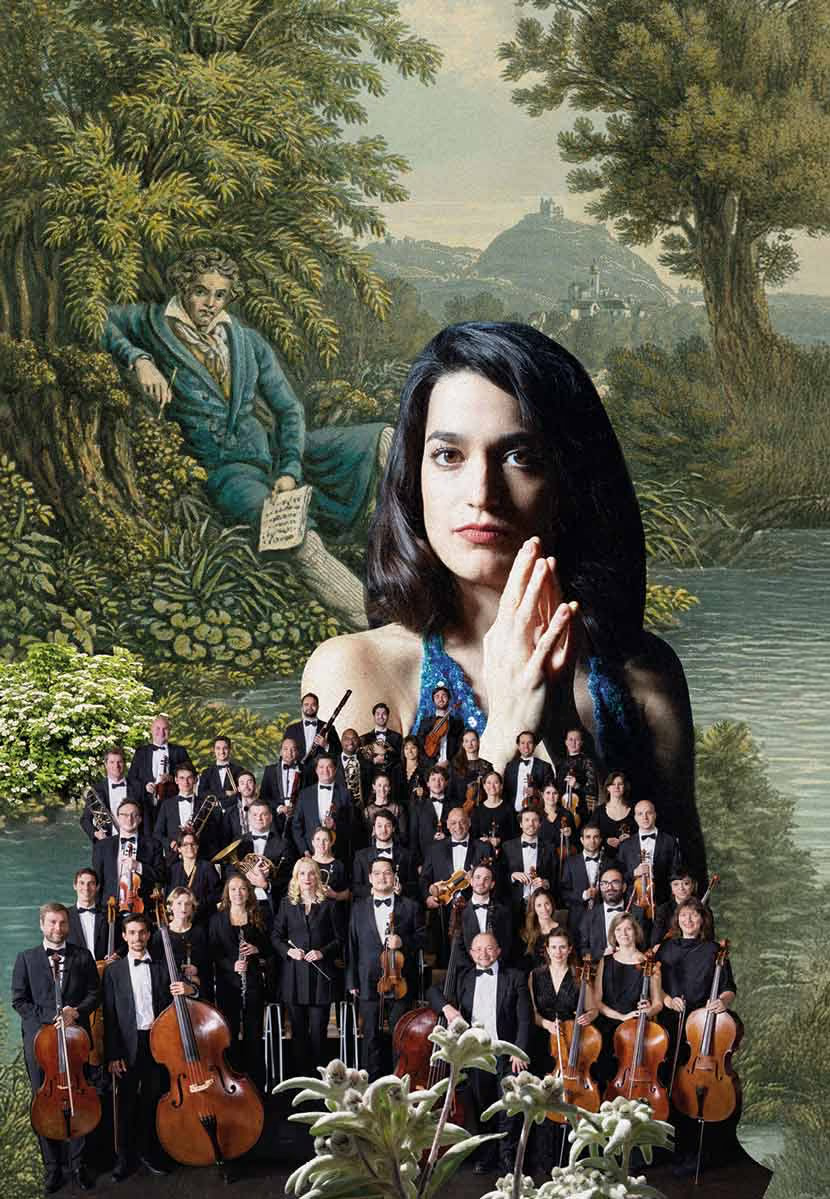
There’s no doubt about it: music is made up of notes. And the most common of all notes, arguably the most banal, is at the heart of this concert programme: C, the central key on every keyboard and the natural limit of our tonal scale (C2–c5). C major is often perceived as being the key of serenity, clarity, lightness and universality, and we associate it with joy, happiness and optimism. It’s hardly surprising that Mozart’s most popular, best-known symphony in C major was subsequently nicknamed the “Jupiter” on account of its majestic aura and the splendour of its music, but also because this symphony was his ultimate work in the genre. Music historians have long declared it to be the crowning finale of Mozart’s series of symphonies, and attribute it with divine perfection. And this work is truly radiant and flooded with light.
Beethoven’s Piano Concerto No. 3 also ends in a serene C major, though the predominant key of this work is actually c minor, which we often associate with serious, sombre moods. This lends the music an atmosphere of grief, pensiveness and dramatic intensity that nevertheless radiates power and strength. Beethoven’s choice of this key – which stands in such obvious contrast to the radiance of C major – might well have been influenced by Mozart, whose Piano Concerto K. 491, which Beethoven greatly admired, is also in c minor.
Helena Winkelman feels inspired by the idea that trees can communicate with each other. So in Tree Talk, she has created a work that endeavours to capture in music the relationship between trees and the Nature that surrounds them. Just as a tree is exposed to the passing of the seasons, Winkelman’s piece plays with overtones to demonstrate shifts in tone colours and movement. The solo cellos play their open strings and fan out into their harmonic space, as it were: We cannot determine any basic key, just the constant shifting of the sound. In contrast, the Overture to Konrad Adolf Dyhrn’s tragedy Konradin by the composer Friedrich Theodor Fröhlich once more focuses on c minor. When heard in combination with the other works on the programme here, the diversity and expressiveness of this music become all the clearer. Starting off with the basic note of C, musical spaces unfold that are able to trigger all manner of emotions, from melancholy sadness to radiant happiness.
Lineup
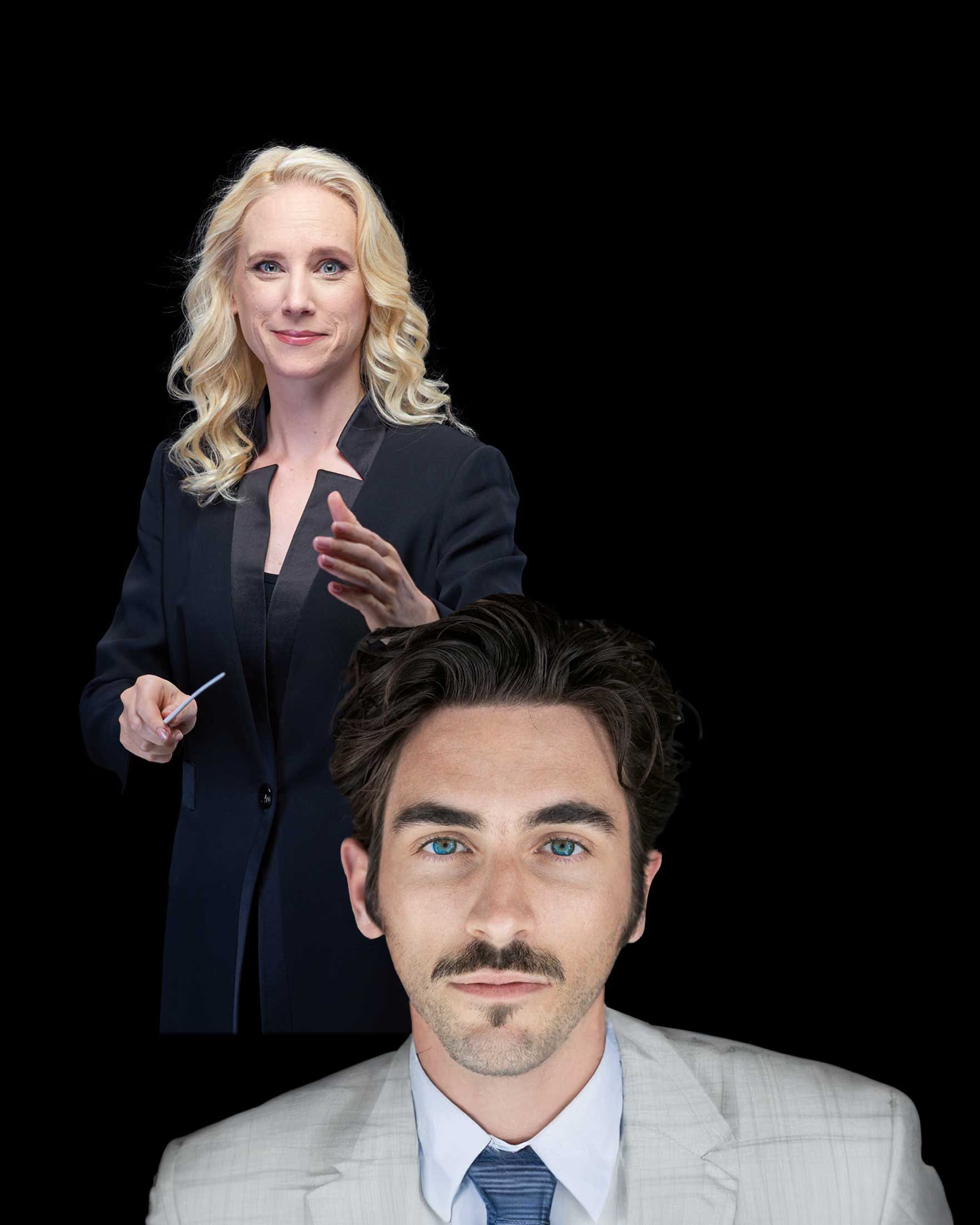
TEO GHEORGHIU, piano
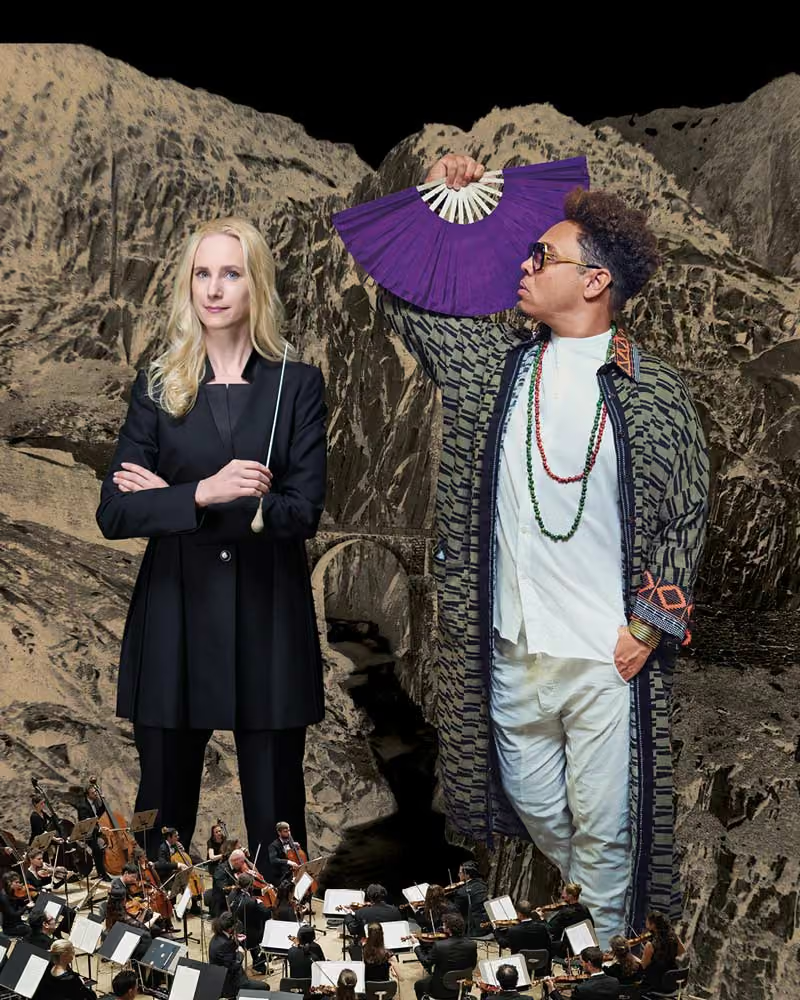
SWISS ORCHESTRA
LENA-LISA WÜSTENDÖRFER, conductor
programme
FRIEDRICH THEODOR FRÖHLICH (1803 BRUGG – 1836 AARAU)
Overture to Dyhrn’s «Konradin»
LUDWIG VAN BEETHOVEN (1770–1827)
Concerto for piano No. 3 in c minor, op. 37
HELENA WINKELMAN (* 1974 SCHAFFHAUSEN)
«Tree Talk» for 2 cellos and string orchestra
WOLFGANG AMADEUS MOZART (1756–1791)
«Jupiter Symphony» No. 41 in C major, K. 551
Salle Equilibre
Fribourg

How to get there
BY PUBLIC TRANSPORT
About 3 minutes on foot from Freiburg train station
Bus lines 1, 2, 3, 4, 5, 6, 7, 8, 9 and 11 to Fribourg railway station stops
Bus lines 1, 2, 3, 5 and 6 to St. Pierre stop
BY CAR
Car parks: Grand-Places, Fribourg Centre and Parking des Alpes
Outside: Parking des Bourgeois
barrier-free access
WHEELCHAIR
All public areas are accessible to people with reduced mobility. Seats are reserved for wheelchair users in every theatre hall. If you would like to make use of this, please reserve your seats at the ticket office at least 24 hours before an event.
Please indicate whether you will be accompanied. In this case, your accompanying person can attend the performance next to you.
HEARING IMPAIRMENT
Our theatre rooms are all equipped with an induction loop. People with hearing aids are asked to set them to position T and reserve a place in the following rows:
Equilibre: seat rows D to P
Garderobe
evening ticket office
Open one hour before each performance, tickets are sold only for the show of the day.
Doors open / late entry
Discount
The discounted rate applies to students, learners, unemployed people and AHV or IV recipients.
The Child rate only valid up to the age of 15 and for performances at which it is offered. Children receive the discounted rate for all other events.
The profit rate Is uniformly 20.— upon presentation of a professional ID. The members of the Association vaudoise de danse contemporaine (AVDC) is uniformly 20.— for all dance performances.
The FKO special rate applies to students from the Freiburg Conservatory and to students from HEMU and the Department of Musicology at UniFR and is Fr. 10.—.
The one from CARITAS KulturLegi Freiburg allows its holders to receive a 50 percent discount on the reduced individual adult ticket and 30 percent discount on the individual children's ticket.
Teo Gheorghiu is very popular in Switzerland and in recent years has also established an international reputation. Piano News magazine recently described him as a “fabulous, mature, intelligent pianist”. Gheorghiu made his debut in the Zurich Tonhalle at the age of 12, playing Schumann’s Piano Concerto. Since then, he has cultivated a versatile repertoire and has performed with orchestras such as the Royal Philharmonic, the Pittsburgh Symphony, the Orquestra Sinfonica de Bilbao, the Danish National Symphony, the Tchaikovsky Symphony Orchestra of Moscow and the Zurich Tonhalle Orchestra. He regularly collaborates with the Zurich Chamber Orchestra and the Musikkollegium Winterthur. His solo recitals have taken him to all the main Swiss cities and also to London (the Wigmore Hall), Hamburg (the Elbphilharmonie), Tokyo (Suntory Hall), Milan (Societa del Quartetto) and Santiago, as well as to the Beethoven Festival in Bonn, the Dvořák Festival in Prague, to the Louvre and to festivals in Bucharest, Gstaad, Verbier, Lucerne and Mecklenburg-Vorpommern.
In 2020, the CD label Claves began a long-term collaboration with Teo Gheorghiu. Their first CD was entitled Duende and featured works by Enrique Granados, Isaac Albéniz, Claude Debussy, Maurice Ravel and Manuel de Falla. It was acclaimed enthusiastically by the public and press alike and was honoured with the Diapason d’Or. His latest album, Roots, was inspired by a cycle tour that he undertook from his home town in the Zurich Oberland to the country of his ancestors, Romania.
Teo Gheorghiu was born in 1992. He won first prize at the San Marino International Piano Competition in 2004 and first prize at the International Franz Liszt Piano Competition in Weimar the following year. In 2010, he was awarded the Beethoven Ring by the Beethoven Festival in Bonn.
For everyone who wants to hear Swiss symphonic music, and to live it too
Enjoy exclusivebenefits, get a glimpse behind the scenes, and do a good thing